Introduction
Ever wondered how your laptop, phone, or smart TV connects to the internet without any cables? That’s the magic of 802.11 Wireless! Let’s break down what it is, how it works, and why it’s the reason you can binge-watch shows or video call your friends from anywhere in your home.
What is 802.11 Wireless?
802.11 is a set of IEEE standards that define how wireless local area networks (WLAN) work. In simple terms, it’s the technology behind Wi-Fi. Over the years, different versions of 802.11 have been developed, each improving speed, range, and reliability.
Key Variants of 802.11 Wireless
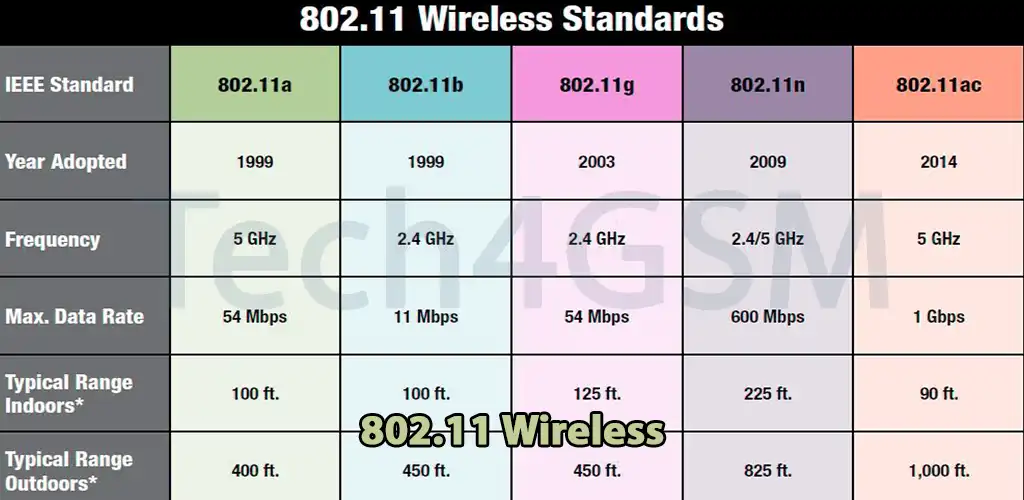
Here’s a quick look at the most common versions:
- 802.11b
- One of the earliest standards.
- Offers speeds up to 11 Mbps.
- Works on the 2.4 GHz frequency, which is prone to interference from devices like microwaves.
- 802.11g
- An upgrade to 802.11b.
- Offers speeds up to 54 Mbps.
- Backward compatible with 802.11b, meaning devices supporting both are often labeled 802.11b/g.
- 802.11n
- A significant leap forward.
- Offers speeds up to 600 Mbps (theoretical).
- Uses MIMO (Multiple Input Multiple Output) technology for better range and performance.
- Works on both 2.4 GHz and 5 GHz frequencies.
Why 802.11g is Still Relevant
Even though newer standards like 802.11n and 802.11ac exist, 802.11g remains popular because:
- Backward Compatibility: It works with older 802.11b devices.
- Good Enough for Basics: With speeds up to 54 Mbps, it’s sufficient for browsing, streaming, and light gaming.
- Widespread Support: Many devices still support 802.11g, making it a reliable choice.
How 802.11 Wireless Works
802.11 wireless uses radio waves to transmit data between your device (like a laptop) and a router. Here’s how it happens:
- Your device sends a request to the router (e.g., “Load this webpage”).
- The router processes the request and sends the data back to your device.
- The data travels through the air as radio waves, which your device picks up and converts into the webpage, video, or file you see.
Related Terms
- Wi-Fi: The common name for 802.11 wireless networks.
- Router: The device that creates a Wi-Fi network and connects your devices to the internet.
- Mbps (Megabits per second): A measure of internet speed.
Fun Fact
The first 802.11 standard was introduced in 1997. Since then, Wi-Fi has become a must-have in homes, offices, and even public spaces like cafes and airports.
Why 802.11 Wireless Matters to You
802.11 wireless is the reason you can:
- Stream movies without buffering.
- Play online games with friends.
Work from home without messy cables.