Introduction
In the ever-evolving world of networking, Classless Inter-Domain Routing (CIDR) has become a cornerstone for efficient IP address management. As the internet expands into 2025, understanding CIDR is critical for optimizing networks, reducing costs, and improving performance. Let’s dive into this revolutionary system and explore how it works, its benefits, and practical applications.
What is CIDR?
CIDR (Classless Inter-Domain Routing) is a flexible method for allocating and routing IP addresses. Introduced in 1993, it replaced the outdated classful addressing system (Class A, B, C) that caused massive IP address wastage. Instead of rigid classes, CIDR uses a variable-length subnet mask (VLSM) to create networks of any size, ensuring optimal use of IP addresses.
Key Idea:
CIDR groups IP addresses into “blocks” based on a shared network prefix (e.g., 192.168.1.0/24). The slash notation (e.g., /24) indicates how many bits represent the network, while the remaining bits identify hosts.
The Problem with Classful Addressing
Before CIDR, IP addresses were divided into fixed classes:
- Class A: 16 million hosts (Massive, often wasted).
- Class B: 65,000 hosts (Still too large for most).
- Class C: 254 hosts (Too small for growing organizations).
Example of Wastage:
If a company needed 500 hosts, it had to choose a Class B network (65,000 addresses), wasting 64,500 IPs. This inefficiency accelerated IPv4 exhaustion.
How CIDR Works: Breaking Down the Basics
CIDR solves this with two innovations:
- Variable-Length Subnet Masking (VLSM):
- Networks can be split into custom-sized subnets.
- Example: A
/26block provides 64 IPs (e.g., for a small office), while a/20offers 4,096 IPs (for a large enterprise).
- Route Aggregation (Supernetting):
- Combines multiple IP blocks into a single routing entry.
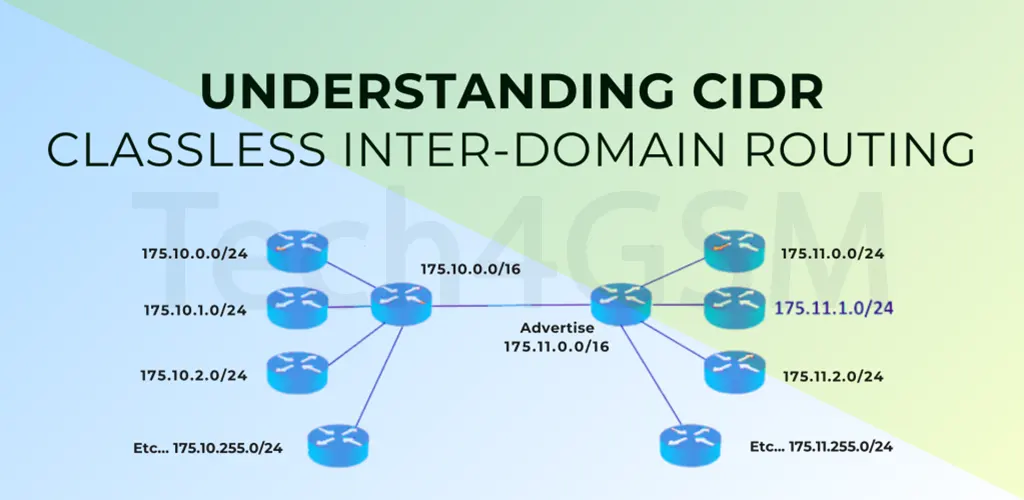
- Reduces routing table size, speeding up internet traffic.
CIDR Notation: Understanding the Format
CIDR addresses follow the format:
a.b.c.d/n
a.b.c.d: IP address (e.g.,192.168.1.0)./n: Prefix length (e.g.,/24= 24 network bits).
Example:
10.2.3.128/25 means:
- Network bits: First 25 bits.
- Host bits: Last 7 bits (128 total addresses).
Advantages of CIDR in 2025
- Efficient IP Usage:
- Assign exact-sized blocks, minimizing waste.
- Simplified Routing:
- Aggregated routes shrink global routing tables by 90%.
- Flexible Subnetting:
- Create subnets for departments, IoT devices, or cloud services.
- Cost Savings:
- Reduce ISP fees by leasing only needed IPs.
- IPv4 Lifespan Extension:
- Delay IPv6 migration with smarter IPv4 allocation.
Disadvantages of CIDR
- Complex Configuration:
- Requires understanding binary math and subnetting.
- Legacy Compatibility Issues:
- Older hardware/software may not support CIDR.
- Security Challenges:
- Dynamic subnets complicate firewall rule management.
Rules for Creating CIDR Blocks
To form valid CIDR blocks, follow these rules:
- Contiguous IPs: Addresses must be sequential (e.g., 192.168.1.0–192.168.1.15).
- Block Size = 2^n: Sizes like 16 (2⁴) or 512 (2⁹) ensure easy division.
- Divisible First IP: The starting IP must align with the block size.
Example:
Is 100.1.2.32 – 100.1.2.47 a valid block?
- Contiguous? Yes (16 addresses).
- Block Size: 16 = 2⁴ ✔️
- First IP:
100.1.2.32in binary ends with00100000. Last 4 bits (host) are zero ✔️
Result: Valid CIDR block (100.1.2.32/28).
CIDR vs. Classful Addressing
| Feature | Classful | CIDR |
|---|---|---|
| Flexibility | Fixed classes | Custom-sized blocks |
| Efficiency | High wastage | Minimal waste |
| Routing Tables | Large and bloated | Compact (aggregated) |
| Subnetting | Not supported | Supported via VLSM |
CIDR in 2025: Real-World Applications
- Cloud Hosting:
- AWS and Azure use CIDR to allocate dynamic IPs for scalable VM clusters.
- IoT Networks:
- Assign tiny
/30blocks (4 IPs) to smart devices.
- Assign tiny
- Enterprise Networks:
- Divide a
/16block into/24subnets for offices globally.
- Divide a
- ISP Management:
- Lease
/22blocks to small businesses instead of Class C.
- Lease
FAQs About CIDR
Q1: What problem does CIDR solve?
CIDR tackles IPv4 exhaustion by replacing rigid class-based blocks with customizable sizes. This reduces waste and delays the need for IPv6.
Q2: How does CIDR improve routing?
By aggregating routes. For example, 10 /24 subnets can merge into one /20 entry, cutting router workload.
Q3: Can CIDR work with IPv6?
Yes! IPv6 inherently uses CIDR-like notation (e.g., 2001:db8::/32).
Q4: What’s the role of subnet masks in CIDR?
A subnet mask (e.g., 255.255.255.0) defines network/host bits. CIDR replaces this with slash notation (e.g., /24).
Conclusion
As we move into 2025, CIDR remains vital for efficient IP management. Its flexibility, scalability, and route aggregation capabilities make it indispensable for ISPs, enterprises, and cloud providers. By mastering CIDR, you’ll optimize your network’s performance and prepare for future growth.