Introduction
Remember the early 2000s, when waiting for a video to buffer felt like watching paint dry? HSDPA (High-Speed Downlink Packet Access) swooped in to rescue us from sluggish 3G speeds, making mobile internet feel almost fast. Let’s rewind and explore how this tech upgrade changed the game—and why you might still see “HSPA” on your phone today!
HSDPA Explained: Faster Downloads, Fewer Tears
HSDPA was a major upgrade to 3G (UMTS) networks in the mid-2000s. It focused on one thing: supercharging download speeds for everything from web pages to music. Think of it as adding rocket fuel to your mobile data!
How Fast Was It?
- Original 3G: ~384 kbps (a 5MB song took ~2 minutes).
- HSDPA: Started at 1.8 Mbps (same song in ~20 seconds) and later hit 21 Mbps (near-instant).
Suddenly, streaming YouTube on a phone wasn’t a fantasy!
How Did HSDPA Work? A Simple Breakdown
HSDPA wasn’t magic—just smart engineering:
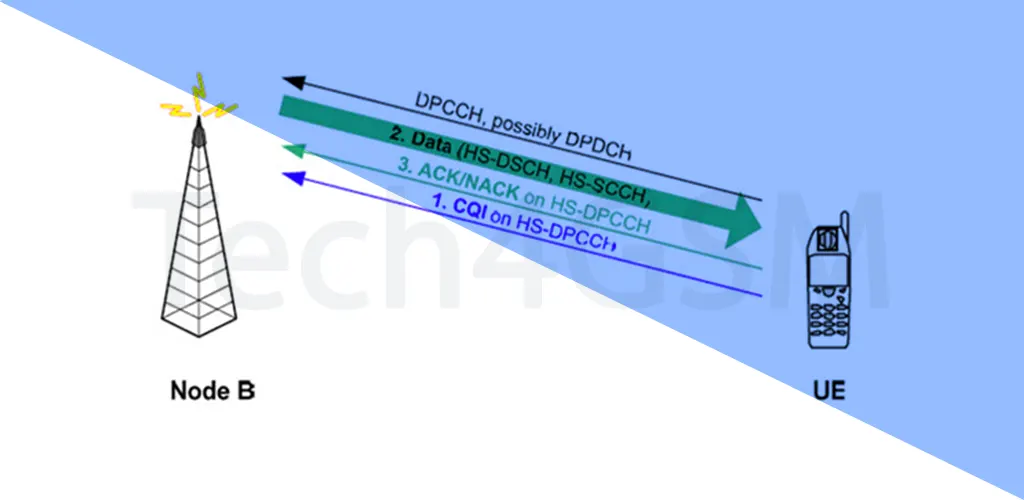
- Efficient Data Chunking: Sent data in smaller, optimized packets.
- Adaptive Modulation: Adjusted signal quality based on network conditions (like a car shifting gears).
- Multi-Code Transmission: Used multiple “lanes” of the network to send data simultaneously.
Imagine upgrading a single-lane dirt road to a 4-lane highway with traffic lights that adapt to rush hour. That’s HSDPA!
The Speed Evolution: From 1.8 Mbps to 21 Mbps
HSDPA rolled out in phases, each faster than the last:
- Phase 1 (1.8 Mbps): Basic video streaming (with patience).
- Phase 2 (3.6 Mbps): Smoother music downloads.
- Phase 3 (7.2 Mbps): Decent video calls.
- Phase 4 (14.4 Mbps / 21 Mbps): Near-broadband speeds for early smartphones.
Fun Fact: The iPhone 3G supported 7.2 Mbps HSDPA—considered lightning-fast in 2008!
HSDPA vs. HSUPA: A Tag Team Called HSPA
HSDPA had one flaw: it only boosted downloads. Uploads (like sending photos) still crawled on old 3G tech. Enter HSUPA (High-Speed Uplink Packet Access):
- HSDPA: Handled speedy downloads.
- HSUPA: Sped up uploads (up to 5.76 Mbps).
Together, they formed HSPA (High-Speed Packet Access), the full package for 3.5G networks.
Why Did HSDPA Matter?
- Made Mobile Internet Usable: Buffering reduced, apps loaded faster.
- Paved the Way for 4G: Techniques like adaptive modulation became LTE staples.
- Boosted Business: Faster emails and file downloads on-the-go.
Even today, phones often show “HSPA” when 4G/5G isn’t available—a nod to this legacy tech.
HSDPA’s Legacy: The Bridge to Modern Speeds
While 4G and 5G have left HSDPA in the dust, its impact lingers:
- Network Efficiency: Taught carriers how to optimize data traffic.
- User Expectations: Proved people wanted (and would pay for) faster mobile data.
- Tech Foundations: Inspired features like carrier aggregation in 4G.
Could You Still Use HSDPA Today?
Technically, yes! Many global 3G networks still support HSPA. But with 4G/5G offering 100x faster speeds, HSDPA is now a backup for weak signal areas. Still, it’s a comforting sight when your phone drops to “H” or “3G”!
Final Thoughts
HSDPA was the unsung hero that dragged 3G into the modern era. It transformed mobile internet from a luxury to a practical tool, setting the stage for today’s streaming, scrolling, and snapping. Next time you binge a TikTok video, thank HSDPA for laying the groundwork!
In a Nutshell: HSDPA = 3G’s speed upgrade (up to 21 Mbps downloads). Paired with HSUPA, it became HSPA—the “fast” 3.5G we relied on before 4G. Still kicking in some corners of the world!