Introduction
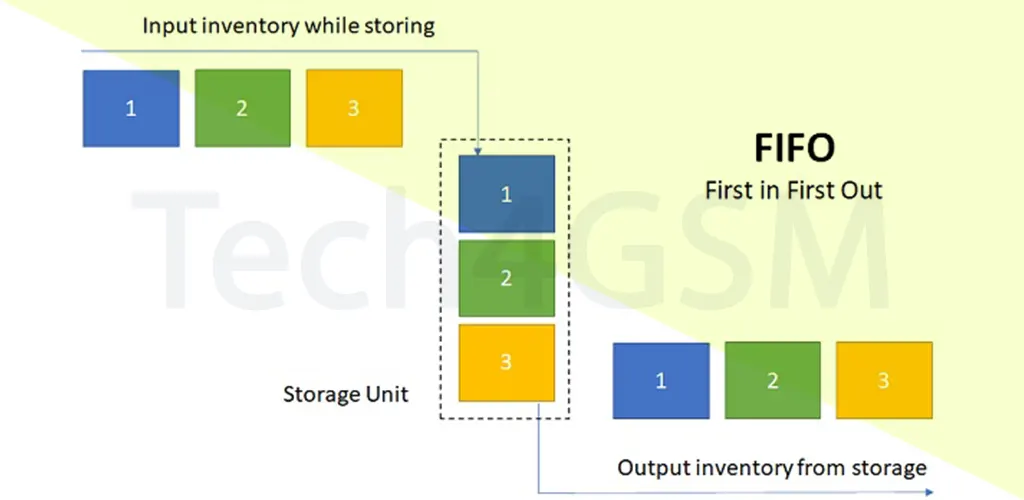
FIFO stands for “First In, First Out”. It’s a simple but powerful concept used in inventory management, accounting, and even everyday life. Imagine a grocery store selling milk: the oldest cartons (closest to expiry) are stocked in front, ensuring they’re sold first. This logic prevents waste and keeps inventory fresh.
In business terms, FIFO means older inventory is sold or used before newer stock. This method ensures that the cost of goods sold (COGS) reflects the earliest purchases, while remaining inventory matches recent costs.
Why does FIFO matter in 2025?
With global supply chains becoming more complex, FIFO helps businesses maintain accuracy in financial reporting, reduce waste, and comply with regulations. Let’s break it down!
How FIFO Works: A Step-by-Step Example
Let’s say Tech4GSM, a smartphone retailer, buys components:
- January 2025: 100 units at $10 each
- March 2025: 150 units at $12 each
- May 2025: 200 units at $15 each
If Tech4GSM sells 300 units by July 2025, FIFO assigns costs as follows:
- First 100 units from January: 10/unit→∗∗1,000**
- Next 150 units from March: 12/unit→∗∗1,800**
- Remaining 50 units from May: 15/unit→∗∗750**
Total COGS = 1,000+1,800 + 750=∗∗3,550**
Remaining Inventory = 150 units from May at 15→∗∗2,250**
This method ensures older stock is cleared first, reflecting real-world inventory flow.
Key Benefits of FIFO
- Prevents Obsolescence:
- Selling older stock first reduces the risk of holding outdated items.
- Simplifies Accounting:
- Matches natural inventory flow, making financial statements easier to audit.
- Higher Net Income in Inflation:
- Older, cheaper costs are recorded as COGS, boosting profits (but may increase taxes).
- Globally Accepted:
- Compliant with International Financial Reporting Standards (IFRS), preferred in over 140 countries.
- Accurate Inventory Valuation:
- Ending inventory reflects current market prices, offering a realistic balance sheet.
Drawbacks of FIFO
- Higher Tax Liability:
- Increased profits mean businesses pay more taxes in inflationary periods.
- Mismatch in Costs & Revenue:
- If old inventory costs are low but selling prices are high, profits may be overstated.
- Not Ideal for All Industries:
- Industries like pharmaceuticals or fashion (where new stock is prioritized) might prefer LIFO (Last In, First Out).
- Complexity in Rising Prices:
- Managing COGS becomes tricky if older stock costs vary widely.
FIFO vs. LIFO vs. Average Cost: Quick Comparison
| Method | How It Works | Best For |
|---|---|---|
| FIFO | Oldest inventory sold first | Inflationary markets, perishables |
| LIFO | Newest inventory sold first | Declining prices, tax savings |
| Average | Weighted average cost per unit | Stable prices, simplicity |
Example: In 2025, if inflation rises to 8%, FIFO shows higher profits than LIFO, impacting investor decisions.
Why FIFO Dominates Global Markets in 2025
- Regulatory Compliance:
- IFRS mandates FIFO, making it essential for multinational companies.
- Tech-Driven Inventory Systems:
- Tools like AI and IoT automate FIFO tracking in warehouses.
- Consumer Demand for Freshness:
- E-commerce giants like Amazon use FIFO to ensure timely delivery of non-expired goods.
- Transparency:
- Investors trust FIFO-based financials for accurate performance metrics.
Calculating FIFO: A Simple Formula
- List inventory purchases chronologically.
- Assign costs starting from the oldest batch.
- Multiply units sold by their respective costs.
- Sum up for total COGS.
Pro Tip: Use spreadsheet formulas or inventory software to automate this process.
FAQs About FIFO
Q1: Is FIFO mandatory everywhere?
- No. The U.S. allows LIFO under GAAP, but FIFO is required under IFRS. Always check local laws.
Q2: How does FIFO affect cash flow?
- Higher profits mean more taxable income, potentially reducing cash reserves.
Q3: Can FIFO be used for digital products?
- Yes! Even digital services (e.g., software licenses) apply FIFO to track subscription renewals.
Q4: Does FIFO work for the automotive industry?
- Absolutely. Car manufacturers use FIFO to manage parts inventory and avoid obsolete stock.
The Future of FIFO in 2025 and Beyond
With advancements in blockchain and real-time tracking, FIFO is evolving. Companies now integrate sensors and RFID tags to monitor stock age automatically. This reduces human error and enhances compliance.
Final Takeaway:
FIFO isn’t just an accounting term—it’s a strategic tool for optimizing inventory, maximizing profits, and building trust in 2025’s competitive markets.