Introduction
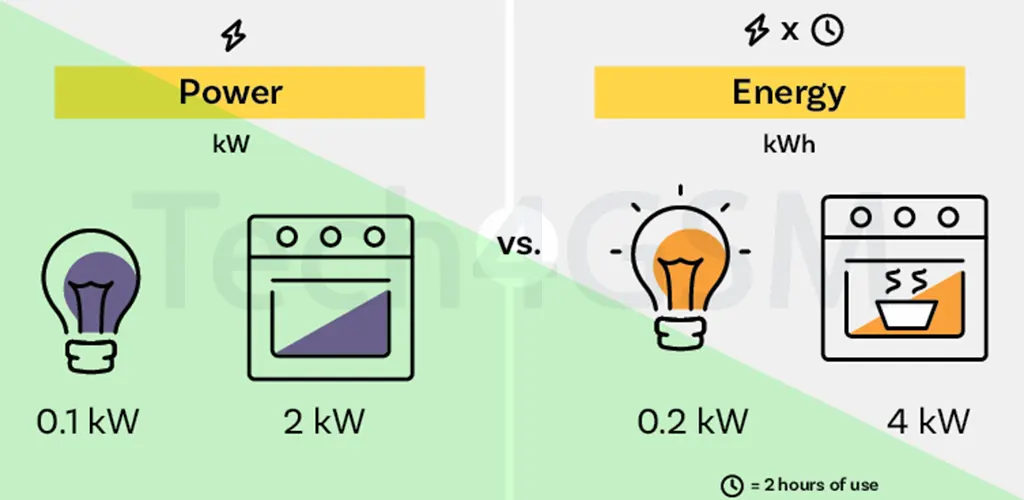
A kilowatt-hour (kWh) is the unit used to measure energy consumption. It represents using 1,000 watts of power for one hour. For example, if you run a 1,000-watt microwave for 1 hour, you’ve used 1 kWh of energy.
Think of it like a car’s fuel efficiency:
- Kilowatt (kW) = Speed (how fast you’re driving).
- Kilowatt-hour (kWh) = Distance traveled (how far you go at that speed).
So, kWh tells you the total energy consumed over time, not the rate of use.
Kilowatt vs. Kilowatt-Hour: What’s the Difference?
- Kilowatt (kW): Measures power (how much energy a device needs to start or run).
- Example: A 2 kW air conditioner requires 2,000 watts to function.
- Kilowatt-hour (kWh): Measures energy usage over time.
- Example: Running that 2 kW AC for 3 hours uses 6 kWh (2 kW x 3 hours).
Real-Life Analogy:
Imagine filling a bucket with water:
- kW = How fast the water flows from the tap.
- kWh = Total water in the bucket after 1 hour.
What Can 1 kWh Power?
Here’s how far 1 kWh goes in everyday appliances:
- LED TV (50”): Watch for 20 hours (50 watts).
- Refrigerator: Run for 3 hours (300 watts).
- Oven (Baking): Cook for 30 minutes (2,000 watts).
- Gaming Console (PS5): Play for 6-7 hours (150 watts).
Pro Tip: Lower-watt devices use less kWh, saving you money!
How to Calculate kWh for Any Appliance
Follow these 4 simple steps:
- Find the appliance’s wattage (check the label or manual).
- Convert watts to kilowatts (divide by 1,000).
- Example: 1,200-watt dishwasher = 1.2 kW.
- Multiply by hours used daily.
- Example: 1.2 kW x 2 hours = 2.4 kWh/day.
- Calculate monthly usage: Multiply daily kWh by 30.
- 2.4 kWh x 30 = 72 kWh/month.
Formula:
kWh = (Watts ÷ 1,000) × Hours Used
kWh Consumption of Common Appliances
| Appliance | Wattage | kWh per Hour | Monthly Usage (Est.) |
|---|---|---|---|
| LED TV (50”) | 50W | 0.05 kWh | 15 kWh (5 hrs/day) |
| Refrigerator | 300W | 0.3 kWh | 54 kWh |
| Air Conditioner | 3,000W | 3 kWh | 360 kWh (4 hrs/day) |
| Washing Machine | 500W | 0.5 kWh | 15 kWh (10 loads) |
| Laptop | 50W | 0.05 kWh | 3 kWh (2 hrs/day) |
How Many kWh Does a Home Use?
The average U.S. household uses 886 kWh/month (29.5 kWh/day). Factors affecting usage:
- Home size: Larger homes need more heating/cooling.
- Climate: Extreme temperatures increase AC/heating use.
- Appliances: Older devices consume more energy.
Regional Example:
- Texas homes average 1,176 kWh/month due to higher AC demand.
Saving Money with kWh Knowledge
- Track Usage: Use smart meters or apps like Sense to monitor real-time kWh.
- Switch to LEDs: A 10W LED bulb uses 90% less energy than a 100W incandescent.
- Unplug Vampire Devices: Electronics on standby (TVs, chargers) drain 5-10% of your bill.
- Time Your Use: Run dishwashers or dryers during off-peak hours for lower rates.
Case Study:
By replacing a 15-year-old fridge (600 kWh/year) with an Energy Star model (300 kWh/year), you save **45/year∗∗(at0.15/kWh).
Other Electrical Units Explained
- Volts (V): Electrical “pressure” (e.g., 120V in U.S. outlets).
- Amps (A): Current flow (e.g., a blender uses 5-10A).
- Ohms (Ω): Resistance to current (higher ohms = less current).
- Megawatt (MW): 1 million watts (powers 330 homes for 1 hour).
FAQs
1. How much is 1 kWh in cost?
- Average U.S. rate: 12-30 cents/kWh. Check your bill for exact rates.
2. Can solar panels reduce kWh costs?
- Yes! A 5kW solar system generates 500-700 kWh/month, slashing bills by 50-90%.
3. What’s a gigawatt (GW)?
- 1 billion watts. A lightning bolt is ~1 GW!
4. How do I read my electricity meter?
- Digital meters display kWh used. Subtract last month’s reading to find current usage.
Final Tips for Lowering kWh Usage
- Seal Windows/Doors: Prevent energy leaks.
- Use Smart Thermostats: Save 10% on heating/cooling.
- Wash Clothes in Cold Water: Reduces water heater kWh by 75%.
By 2025, experts predict smart home tech will help households cut kWh use by 20%! Start today and watch your savings grow.