Introduction
CGI (Common Gateway Interface) is a bridge between web servers and users. It lets servers run programs to process requests and deliver dynamic content. Here’s a simple breakdown of CGI’s role in 2025 web development.
What is CGI?
- CGI stands for Common Gateway Interface.
- It allows web servers to execute scripts/programs when users submit requests (e.g., forms, searches).
- These scripts, written in Python, PHP, or Ruby, generate real-time HTML responses based on user input.
- Example: A weather website using CGI to display location-specific forecasts.
History of CGI
- 1993: CGI was created by the National Center for Supercomputer Applications.
- It revolutionized early web development by enabling server-client communication.
- While newer tech like FastCGI and WSGI now dominate, CGI laid the groundwork for dynamic web apps.
How CGI Works
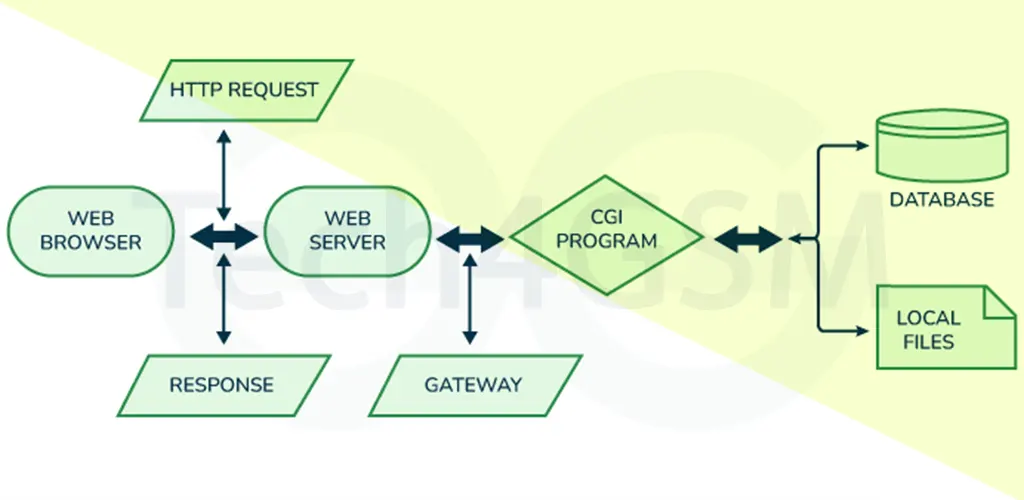
- User Request: A client (browser) sends a request (e.g., submits a form).
- Server Activation: The web server detects a CGI script in the cgi-bin directory and runs it.
- Data Processing: The script uses environment variables (like
QUERY_STRINGorREQUEST_METHOD) to process inputs. - Dynamic Response: The server sends back HTML generated by the script.
GET vs. POST Methods
- GET: Data is visible in the URL (less secure).
- POST: Data is hidden (secure for passwords/payments).
Key Roles of CGI in 2025 Web Development
- Dynamic Content Generation: Turns static pages into interactive experiences (e.g., live chat, calculators).
- Form Handling: Processes user inputs from surveys, logins, or feedback forms.
- Server-Side Scripting: Runs code on the server, reducing client-side load.
- Multi-Language Support: Write scripts in Python, Perl, PHP, etc.
- Database Integration: Connects to databases to fetch/update data (e.g., product listings).
CGI Environment Variables
CONTENT_LENGTH: Size of user-submitted data.REMOTE_ADDR: User’s IP address.REQUEST_METHOD: GET or POST.SCRIPT_NAME: Name of the executed CGI script.
Pros of CGI
✅ Easy to learn and deploy.
✅ Works with any programming language.
✅ Enables real-time user interactions.
✅ Supported by most servers (Apache, Nginx).
Cons of CGI
❌ Slow for high traffic (each request starts a new process).
❌ Security risks if scripts aren’t properly secured.
❌ Lacks modern frameworks for scalability.
FAQs About CGI
Q1: Is CGI still used in 2025?
Yes, but mainly for legacy systems or small projects. Modern apps prefer FastCGI or containerization.
Q2: Which languages support CGI?
Python, Perl, PHP, Ruby, and even C++.
Q3: How secure is CGI?
It’s secure if developers validate inputs and avoid vulnerabilities.
Q4: Can CGI handle large websites?
Not efficiently. Use WSGI or cloud solutions for scalability.
Q5: What’s the cgi-bin directory?
A server folder where CGI scripts are stored for execution.
Conclusion
CGI remains a foundational tool in web development history. While newer technologies offer speed and security, understanding CGI helps developers grasp server-client dynamics. For 2025 projects, consider blending CGI with modern tools for optimal results.