Introduction
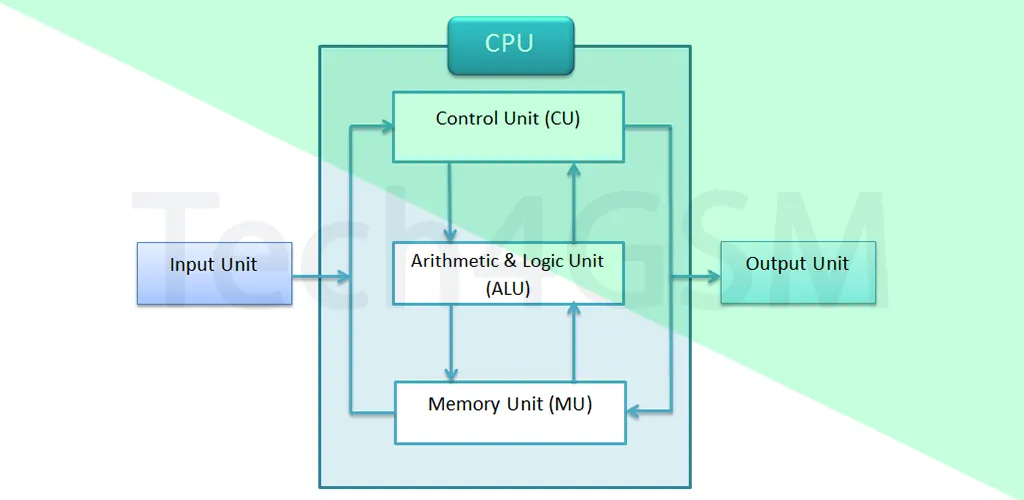
The Arithmetic Logic Unit (ALU) is the “calculator” inside your computer’s brain—the CPU. Made of tiny electrical transistors, it processes all math calculations (like 2+2) and logical decisions (like choosing between yes/no) using binary signals (0s and 1s). Without the ALU, your device couldn’t run apps, play games, or even display this article!
Illustration of ALU
Imagine the ALU as a super-fast math wizard inside your CPU. It works with whole numbers (integers) using circuits, while another part called the Floating-Point Unit (FPU) handles decimals. Together, they power everything from simple math to complex graphics.
How ALUs Evolved: A Quick History
- 1945: Mathematician John von Neumann proposed the ALU concept for early computers.
- 1967: Fairchild’s 3800 became the first ALU on a chip, sparking a tech revolution.
- 2025: Modern ALUs are ultra-efficient, fitting billions of transistors on a chip smaller than a fingernail!
Early computers like the PDP-8 had basic ALUs, but today’s ALUs (like those in your phone) handle tasks millions of times faster.
How Does an ALU Work?
- Data Input: The ALU receives data from memory (e.g., “Add 5 and 3”).
- Decoding Instructions: It reads the opcode (operation code) to know what to do (e.g., add, subtract).
- Crunching Numbers: Using circuits, it calculates results (e.g., 5+3=8).
- Output & Storage: Sends the result back to memory or displays it on your screen.
Fun Fact: ALUs use “half adders” and “full adders”—tiny circuits that handle basic math!
Where Is the ALU Used?
- Smartphones: Powers apps, games, and camera filters.
- Servers: Processes millions of website requests daily.
- IoT Devices: Helps smart thermostats adjust temperatures.
- Self-Driving Cars: Makes split-second decisions to avoid collisions.
Key Components of an ALU
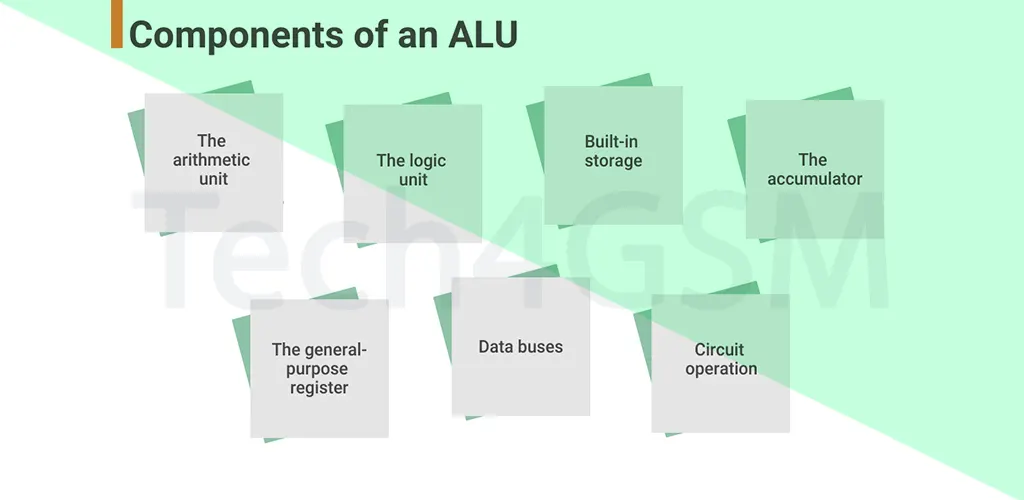
- Arithmetic Unit: Handles +, –, ×, ÷.
- Logic Unit: Manages AND, OR, NOT operations (e.g., “Is this password correct?”).
- Accumulator: Stores temporary results mid-calculation.
- Registers: Quick-access memory for data the ALU uses often.
- Data Buses: Highways that transfer data between ALU and memory.
Pro Tip: The “bit-slice” design lets ALUs split tasks across multiple chips for faster processing!

7 Core Functions of an ALU
- Basic Math: Adds, subtracts, multiplies.
- Advanced Operations: Increments (e.g., ++1) or decrements (e.g., –1) values.
- Logic Checks: Compares numbers (e.g., “Is A > B?”).
- Bit Shifting: Moves binary digits left/right to multiply/divide by 2.
- Data Transfer: Moves results to memory or registers.
- Special Flags: Signals errors (e.g., “Overflow” if a number is too large).
- Custom Operations: Programmable for tasks like encryption.
Did You Know? ALUs in gaming consoles use barrel shifters to render graphics at lightning speed!
Why ALUs Matter in 2025
From streaming 8K videos to AI chatbots, ALUs are the unsung heroes of modern tech. Companies like GBT Technologies are innovating with parallel processing ALUs to boost speeds further. Whether you’re a gamer, programmer, or casual user, the ALU silently powers your digital world.
Final Takeaway
The ALU may be a tiny part of your CPU, but its impact is massive. As we step into 2025, advancements in ALU design will drive faster, smarter, and more energy-efficient devices. Next time your phone unlocks in a flash, thank the ALU! 🚀