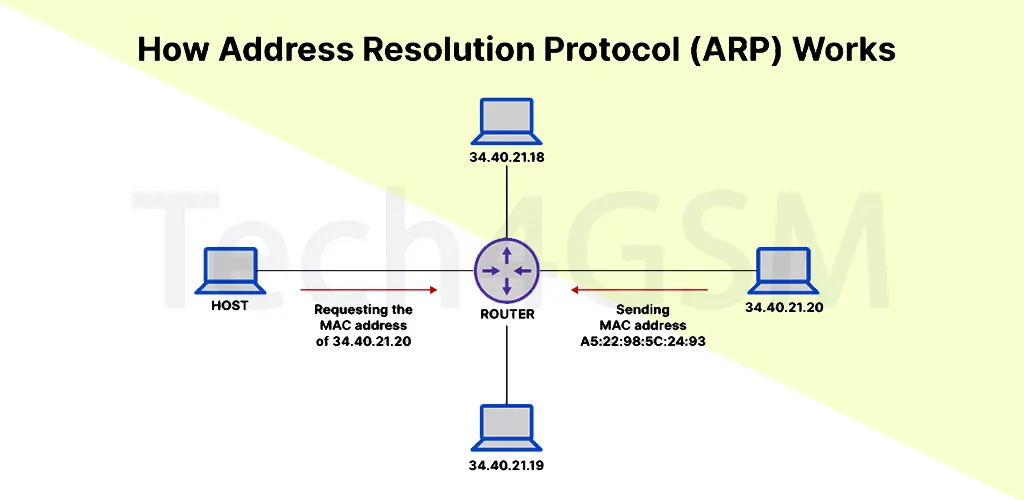
Introduction
When devices chat online, they use IP addresses (like virtual home addresses). But real communication happens via MAC addresses (physical device IDs). ARP bridges this gap, translating IPs to MACs. Let’s break it down!
What is ARP?
Address Resolution Protocol (ARP) is a Data Link Layer protocol in the OSI model. It finds a device’s MAC address using its known IP address. Think of ARP as a phonebook for networks—linking names (IPs) to numbers (MACs).
Key ARP Terms
- Reverse ARP (RARP):
- New devices ask routers for an IP using their MAC address.
- Proxy ARP:
- Routers pretend to be another device, sharing their MAC to connect separate networks.
- Inverse ARP:
- Finds IPs from MACs, common in ATM networks.
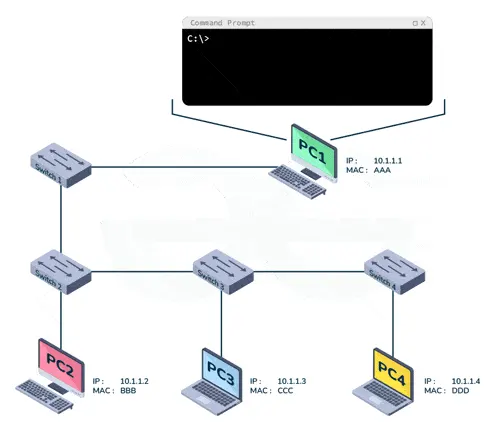
How ARP Works in 4 Steps
- ARP Request (Broadcast):
- Device A shouts, “Who has IP 192.168.1.2? Share your MAC!”
- ARP Response (Unicast):
- Device B replies, “That’s me! My MAC is AA:BB:CC:DD:EE:FF.”
- ARP Cache Storage:
- Device A saves this MAC in its ARP cache for future chats.
- Cache Timeout:
- Entries expire (usually 10-20 mins) to keep the network updated.
Scenarios:
- Same Network: Direct ARP request.
- Different Network: ARP finds the router’s MAC first.
4 Types of ARP
- Proxy ARP: Routers “impersonate” devices to connect subnets.
- Gratuitous ARP: Checks for IP conflicts (like shouting, “Is this IP taken?”).
- Reverse ARP (RARP): New devices ask, “What’s my IP?”
- Inverse ARP: Converts MACs to IPs in ATM networks.
ARP’s Friends: DNS & DHCP
- DHCP assigns IPs dynamically (no duplicates!).
- DNS turns domain names (e.g., google.com) into IPs.
- ARP links those IPs to MACs. Together, they make the internet work!
ARP Security Risks
- ARP Spoofing/Poisoning:
- Hackers fake MAC addresses to intercept data (e.g., Man-in-the-Middle attacks).
- DoS Attacks: Flood networks with fake ARP replies.
Tip: Use static ARP entries or security tools to fight spoofing.
ARP in 2025: What’s Changing?
By 2025, IPv6 adoption will rise, replacing ARP with Neighbor Discovery Protocol (NDP). But ARP remains vital for IPv4 networks.
Pros & Cons of ARP
| Pros | Cons |
|---|---|
| ✅ Fast communication | ❌ Vulnerable to spoofing |
| ✅ Auto-updates MACs | ❌ Broadcasts cause congestion |
| ✅ Works in all networks | ❌ No built-in security |
FAQs
Q: What’s a Man-in-the-Middle (MitM) attack?
A: Hackers secretly relay messages between two parties, stealing data.
Q: What is an ARP cache?
A: A storage table linking IPs to MACs on your device.
Q: How long do ARP entries last?
A: Typically 10-20 minutes before refreshing.
Q: Can ARP be secured?
A: Not natively—use firewalls or encryption tools.
Conclusion
ARP is the unsung hero of networking, translating IPs to MACs so devices can communicate. While risks like spoofing exist, understanding ARP helps you build safer networks. For more tech guides, visit