Introduction
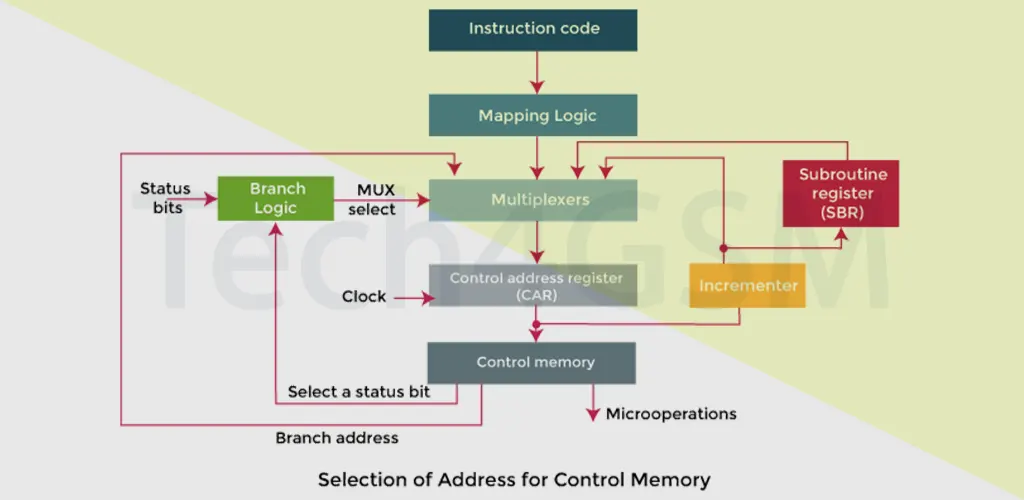
The Control Address Register (CAR), often called the Program Counter (PC), is a tiny but mighty component inside your computer’s CPU. Think of it as a bookmark in a book—it keeps track of which instruction the CPU should execute next. Without the CAR, your computer would be lost, unable to run programs smoothly.
Key Points:
- Location: Embedded in the CPU.
- Purpose: Holds the memory address of the next instruction.
- Nickname: “Program Counter” (PC).
Why is the CAR Important?
Imagine building a puzzle without the picture on the box. The CAR provides that critical roadmap for the CPU to follow. Here’s why it matters:
- Sequential Execution: Ensures the CPU processes instructions in the correct order.
- Efficiency: Speeds up task completion by pre-fetching instructions.
- Error Prevention: Avoids “instruction chaos” by maintaining a clear path.
Did You Know? Modern CPUs use advanced CAR designs to handle multitasking.
How Does the CAR Work? A Step-by-Step Breakdown
Let’s simplify the process:
- Fetch: CAR points to the instruction’s memory address.
- Decode: The CPU interprets the instruction.
- Execute: The instruction runs (e.g., adding numbers).
- Update: CAR moves to the next address (usually +1).
Exception: In loops or jumps, CAR updates to a non-sequential address.
CAR vs. Other Registers: What’s the Difference?
Registers are like mini storage units in the CPU. Here’s how CAR stands out:
| Register Type | Role |
|---|---|
| CAR (PC) | Tracks next instruction address |
| Accumulator | Stores arithmetic results |
| Instruction Register | Holds current instruction |
Real-World Applications of CAR
- Gaming: Enables seamless gameplay by rapidly fetching instructions.
- AI Systems: Manages complex algorithms in machine learning.
- Smartphones: Powers multitasking (e.g., texting while streaming).
2025 Prediction: With quantum computing advancements, CARs may manage qubit instructions!
Future of CAR: What to Expect by 2025
- AI Integration: CARs could predict next instructions using machine learning.
- Quantum Readiness: Enhanced to support quantum computing demands.
- Energy Efficiency: Low-power CAR designs for eco-friendly devices.
FAQ: Your Questions Answered
Q1: Can the CAR be manually modified?
Yes, but only by specific instructions (e.g., jumps or loops).
Q2: What happens if the CAR malfunctions?
The CPU may crash or execute wrong instructions, causing errors.
Q3: Is the CAR the same in all CPUs?
Most follow similar principles, but designs vary (e.g., ARM vs. Intel).
Q4: How does CAR improve gaming performance?
By quickly fetching instructions, reducing lag.
Conclusion
The CAR might be small, but it’s the unsung hero of computing. From your laptop to futuristic AI, it ensures every instruction lands perfectly. As we approach 2025, innovations like quantum-ready CARs will redefine tech!