Introduction
In the world of data communication, ensuring that information is transmitted accurately is critical. Enter CRC (Cyclic Redundancy Check)—a powerful method to detect accidental errors during data transfer. Whether you’re a student, developer, or tech enthusiast, this guide will break down CRC in simple terms, complete with examples, code, and FAQs. Let’s dive in!
What is CRC?
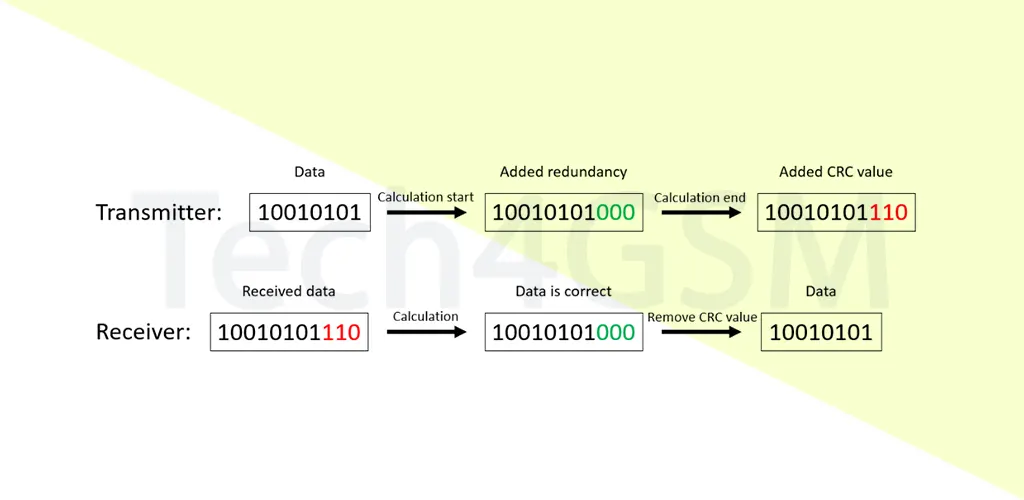
CRC (Cyclic Redundancy Check) is a technique used to detect unintentional changes (errors) in raw data transmitted over networks or stored in devices. It works by adding a “checksum” to the data, which helps the receiver verify if the data arrived intact.
Key Features of CRC
- Simple & Fast: CRC is computationally efficient.
- Widely Used: Found in Ethernet, ZIP files, PNG images, and more.
- Error Detection: Detects burst errors (multiple corrupted bits).
Example 1: No Error in Transmission
Sender Side
Data to Send: 100100
Key (Generator Polynomial): 1101 (represents x3+x2+1)
Step 1: Augment the Data
- Add k−1 zeros (here, k=4, so add 3 zeros).
- Augmented Data:
100100+000=100100000.
Step 2: Modulo-2 Division
- Divide
100100000by1101using XOR operations.
| Step | Current Bits | XOR with Key (1101) | Result | Bring Down Next Bit |
|---|---|---|---|---|
| 1 | 1001 | 1101 | 0100 | 0 → 01000 |
| 2 | 01000 | 0000 (leading 0) | 01000 | 0 → 010000 |
| 3 | 010000 | 0000 | 010000 | 0 → 0100000 |
| 4 | 0100000 | 0000 | 0100000 | 0 → 01000000 |
| 5 | 01000000 | 0000 | 01000000 | 1 → 010000001 |
Final Remainder: 001
Encoded Data Sent: Original data + remainder = 100100001.
Receiver Side
Received Data: 100100001 (no errors)
Step 1: Modulo-2 Division
- Divide
100100001by1101.
| Step | Current Bits | XOR with Key (1101) | Result | Bring Down Next Bit |
|---|---|---|---|---|
| 1 | 1001 | 1101 | 0100 | 0 → 01000 |
| 2 | 01000 | 0000 | 01000 | 0 → 010000 |
| 3 | 010000 | 0000 | 010000 | 0 → 0100000 |
| 4 | 0100000 | 0000 | 0100000 | 0 → 01000000 |
| 5 | 01000000 | 0000 | 01000000 | 1 → 010000001 |
Final Remainder: 000
Conclusion: No errors detected.
Example 2: Error During Transmission
Sender Side
Data to Send: 100100
Key: 1101
Encoded Data Sent: 100100001 (same as Example 1).
Receiver Side
Received Data: 100000001 (error in the 4th bit: 1 → 0)
Step 1: Modulo-2 Division
- Divide
100000001by1101.
| Step | Current Bits | XOR with Key (1101) | Result | Bring Down Next Bit |
|---|---|---|---|---|
| 1 | 1000 | 0000 (leading 1) | 1000 | 0 → 10000 |
| 2 | 10000 | 1101 | 0101 | 0 → 01010 |
| 3 | 01010 | 0000 | 01010 | 0 → 010100 |
| 4 | 010100 | 0000 | 010100 | 0 → 0101000 |
| 5 | 0101000 | 0000 | 0101000 | 1 → 01010001 |
Final Remainder: 101
Conclusion: Non-zero remainder → Error detected.
Why This Works
- Sender appends a checksum derived from the original data.
- Receiver recalculates the checksum. If the data is unchanged, the remainder is zero.
- Modulo-2 Division uses XOR instead of subtraction, making it efficient for binary data.
Visual Recap
Error-Free Transmission
Data: 100100 → Encoded: 100100001
Receiver Division: 100100001 ÷ 1101 = 0 remainder ✔️
Corrupted Transmission
Data: 100100 → Encoded: 100100001
Received: 100000001 (error)
Receiver Division: 100000001 ÷ 1101 = 101 remainder ❌
Key Takeaways
- CRC is Fast: Simple XOR operations make it ideal for real-time systems.
- Detects Burst Errors: Can catch multiple consecutive bit flips.
- Not for Security: CRC only detects accidental errors, not intentional tampering.
How CRC Works: Sender and Receiver
CRC relies on a generator polynomial (a mathematical expression) known to both sender and receiver. Here’s a step-by-step breakdown:
1. Sender Side: Generating the Encoded Data
Step 1: Augment the Data
- Original data:
100100 - Add
k-1zeros (wherekis the key length).- Example: If the key is
1101(k=4), add 3 zeros →100100000.
- Example: If the key is
Step 2: Perform Modulo-2 Division
- Divide the augmented data by the key using XOR operations.
- Remainder from this division becomes the checksum.
Step 3: Send Encoded Data
- Append the checksum to the original data.
- Example: Data becomes
100100001.
- Example: Data becomes
2. Receiver Side: Error Checking
Step 1: Divide Received Data by the Key
- Use the same generator polynomial (key).
- Perform modulo-2 division again.
Step 2: Check the Remainder
- Remainder = 0: No errors detected.
- Remainder ≠ 0: Data is corrupted.
The Magic of Modulo-2 Division
Modulo-2 division uses XOR instead of subtraction. Here’s how it works:
- Align the divisor (key) with the leftmost
1of the dividend. - XOR the divisor with the selected bits.
- Bring down the next bit and repeat until all bits are processed.
- The final remainder is the checksum.
Example: Modulo-2 Division
- Data:
100100000(Augmented) - Key:
1101 - Remainder:
001 - Encoded Data:
100100001
Real-World Examples
Example 1: No Transmission Error
- Sender: Sends
100100001. - Receiver: Divides by
1101. - Remainder:
000→ No error.
Example 2: Error During Transmission
- Corrupted Data Received:
100000001. - Receiver’s Division: Remainder =
101→ Error detected.
Implementing CRC in Code
1. String-Based Approach (C++)
This method uses strings to simulate binary division:
#include <bits/stdc++.h>
using namespace std;

// XOR function for binary strings
string xor1(string a, string b) {
    string result = "";
    for (int i = 1; i < b.length(); i++) {
        if (a[i] == b[i]) result += "0";
        else result += "1";
    }
    return result;
}

// Modulo-2 division
string mod2div(string dividend, string divisor) {
    int pick = divisor.length();
    string tmp = dividend.substr(0, pick);
    while (pick < dividend.length()) {
        if (tmp[0] == '1')
            tmp = xor1(divisor, tmp) + dividend[pick];
        else
            tmp = xor1(string(pick, '0'), tmp) + dividend[pick];
        pick++;
    }
    return tmp;
}

// Encode data with CRC
void encodeData(string data, string key) {
    string appended_data = data + string(key.length()-1, '0');
    string remainder = mod2div(appended_data, key);
    cout << "Encoded Data: " << data + remainder << endl;
}
2. Bit Manipulation Approach (C++)
A faster method using bitwise operations:
#include <iostream>
using namespace std;

// Convert number to binary string
string toBin(long long num) {
    string bin = "";
    while (num) {
        bin = (num & 1 ? "1" : "0") + bin;
        num >>= 1;
    }
    return bin;
}

// CRC using bit manipulation
void CRC(string dataword, string generator) {
    long long gen = stoll(generator, 0, 2);
    long long dword = stoll(dataword, 0, 2);
    long long dividend = dword << (generator.length() - 1);
    int shft = ceil(log2(dividend + 1)) - generator.length();

    while (dividend >= gen || shft >= 0) {
        long long rem = (dividend >> shft) ^ gen;
        dividend = (dividend & ((1 << shft) - 1)) | (rem << shft);
        shft = ceil(log2(dividend + 1)) - generator.length();
    }
    cout << "Codeword: " << toBin((dword << (generator.length()-1)) | dividend) << endl;
}
Why CRC is Not Foolproof
- Detects Accidental Errors Only: CRC can’t protect against intentional tampering.
- Burst Errors Limit: Effectiveness depends on the polynomial’s degree.
FAQs
1. Why Use CRC Instead of Checksums?
CRC detects more error types, especially burst errors, thanks to polynomial division.
2. How is the Generator Polynomial Chosen?
Polynomials are standardized (e.g., CRC-16, CRC-32) for optimal error detection.
3. Can CRC Correct Errors?
No, CRC only detects errors. Use Forward Error Correction (FEC) for correction.
4. Is CRC Used in 5G Networks?
Yes! CRC is vital in 5G for ensuring data integrity.
5. What’s the Time Complexity of CRC?
O(n), where n is data length. It’s efficient for large datasets.
Conclusion
By 2025, CRC will remain a cornerstone in error detection for communication systems. Its simplicity, speed, and reliability make it indispensable.