Introduction
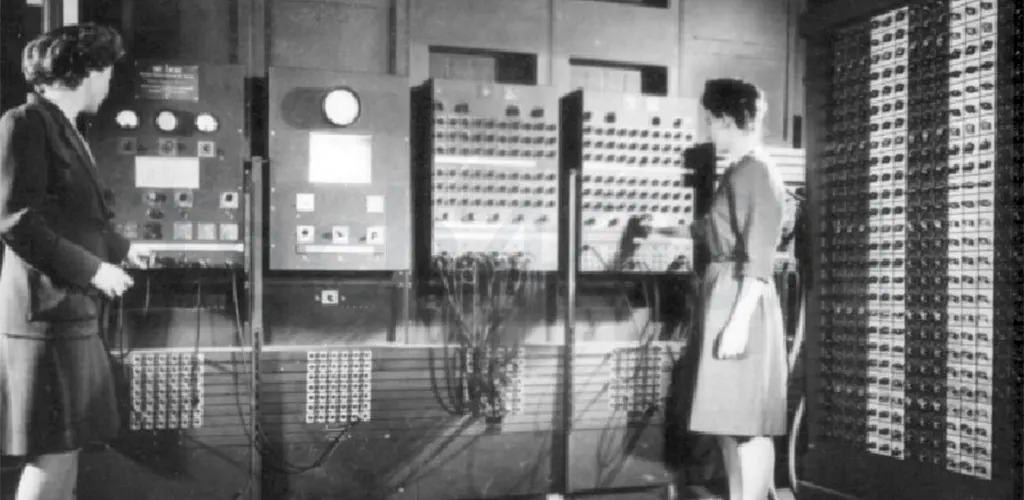
In 1946, a massive machine named ENIAC (Electronic Numerical Integrator and Computer) stunned the world. Touted as the “Giant Brain,” it was the first general-purpose electronic computer, capable of performing calculations 1,000 times faster than any human or mechanical device. Designed during World War II, ENIAC laid the foundation for modern computing. As we approach 2025, its legacy continues to shape technology. Let’s dive into its story, innovations, and the hidden heroes behind its success.
1. The Birth of ENIAC: A War-Time Marvel
Bold Point: ENIAC was born out of World War II’s urgent demands for rapid artillery calculations.
- Military Necessity: The U.S. Army needed precise artillery firing tables to aim weapons accurately. Manual calculations were slow, error-prone, and costly in lives.
- Inventors: Physicist John Mauchly and engineer J. Presper Eckert spearheaded ENIAC’s design, securing Army funding in 1943.
- Secret Development: Built in secrecy at the University of Pennsylvania’s Moore School, ENIAC was unveiled in 1946 after three years of work.
2. ENIAC’s Jaw-Dropping Design
Bold Point: Imagine a computer weighing 30 tons with 18,000 vacuum tubes—ENIAC was a behemoth!
- Physical Size: It occupied 1,800 square feet (about a modern apartment!) with 40 panels arranged in a U-shape.
- Components:
- Vacuum Tubes: 18,000 of these fragile glass tubes processed calculations.
- 7,200 Diodes, 10,000 Capacitors: These parts handled data flow and storage.
- Manual Wiring: Programmers reconfigured ENIAC using 6,000 switches and cables.
- Speed: 5,000 additions per second—a revolutionary feat in the 1940s!
3. Programming ENIAC: A Herculean Task
Bold Point: Programming ENIAC wasn’t for the faint-hearted—it took days to set up a single task!
- Manual Reconfiguration: To switch tasks, programmers physically adjusted cables and dials.
- The First Programmers: A team of six women—Kathleen Antonelli, Jean Bartik, Betty Holberton, Marlyn Meltzer, Frances Spence, and Ruth Teitelbaum—mastered this complex process.
- From “Computers” to Coders: Initially hired as human “computers” for ballistic calculations, they became ENIAC’s first programmers.
- Trailblazers: Their work included debugging, optimizing algorithms, and even creating the first software manual.
4. ENIAC’s Groundbreaking Missions
Bold Point: Beyond artillery tables, ENIAC tackled hydrogen bomb simulations and weather forecasting!
- Hydrogen Bomb Project: In 1945, ENIAC processed 1 million punch cards for the Los Alamos team, exposing design flaws in the H-bomb.
- Post-War Innovations: After moving to Aberdeen Proving Ground in 1947, ENIAC contributed to:
- Atomic Energy Research
- Weather Prediction Models
- Aerodynamic Wind Tunnel Designs
- Retirement: The Army retired ENIAC in 1955 after 70,000 hours of service.
5. The Forgotten Heroes: ENIAC’s Women Programmers
Bold Point: History overlooked these six women until the 1990s—their story is a must-know!
- Pioneering Role: Without formal training, they decoded ENIAC’s schematics and invented programming techniques.
- Legacy: Inducted into the Women in Technology International Hall of Fame (1997), their work inspired generations of coders.
- Impact: They proved programming required creativity and logic—not just engineering.
6. ENIAC vs. Modern Computers: A 2025 Perspective
Bold Point: Your smartphone is millions of times faster than ENIAC—but it owes everything to this pioneer!
- Speed Comparison:
- ENIAC: 5,000 operations/second.
- 2025 Smartphone: ~10 billion operations/second.
- Size & Efficiency: ENIAC’s 30-ton frame vs. today’s nanochips.
7. ENIAC’s Legacy: Shaping the Digital World
Bold Point: ENIAC’s DNA lives in every computer, AI, and cloud system today!
- First Steps to Silicon Valley: Inspired successors like EDVAC and UNIVAC.
- Cultural Impact: Popularized terms like “computer” and “debugging.”
- Historical Preservation: Parts of ENIAC are displayed in museums, including the Smithsonian.
FAQ: Answering Your Burning Questions
Q1: Who invented ENIAC?
A: John Mauchly and J. Presper Eckert, with critical contributions from six female programmers.
Q2: Why were vacuum tubes used?
A: They amplified signals—the only tech available pre-transistors.
Q3: How fast was ENIAC?
A: 5,000 additions/second, making it 1,000x faster than electromechanical machines.
Q4: What happened to ENIAC after 1955?
A: It was dismantled, but sections are preserved in museums.
Q5: Why are the women programmers important?
A: They pioneered programming, yet were unrecognized until decades later.
Q6: Could ENIAC store data?
A: Temporarily, using accumulators—no long-term memory like modern PCs.
Conclusion: ENIAC’s Timeless Impact
As we stride into 2025, ENIAC’s story reminds us that innovation thrives on collaboration, grit, and vision. From artillery tables to AI, its legacy is etched into every digital advancement.