Introduction
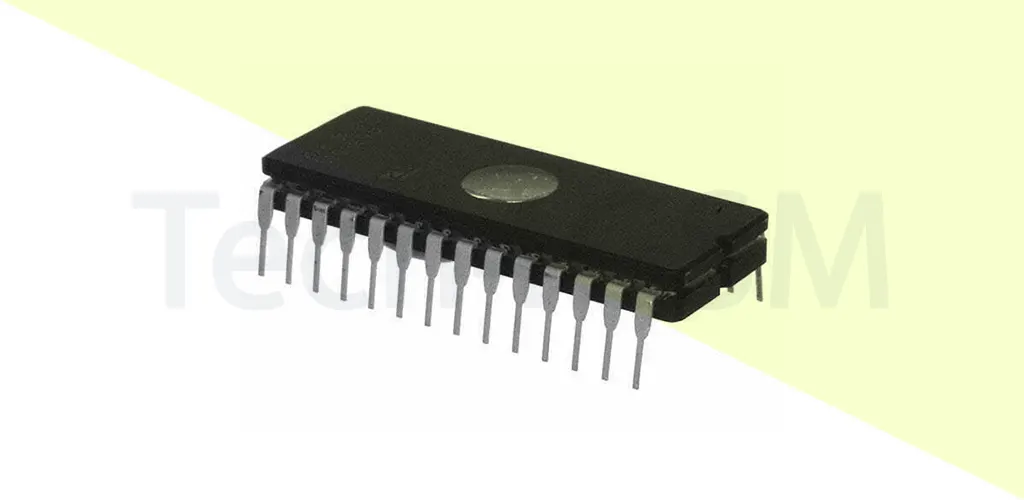
EPROM (Erasable Programmable Read-Only Memory) is a non-volatile memory chip used in computers and electronics to store critical data like firmware, even when power is off. Unlike traditional ROM (permanently programmed during manufacturing), EPROM can be erased and reprogrammed multiple times, making it ideal for iterative development and updates.
Key Features:
- Retains data without power (non-volatile).
- Erasable via ultraviolet (UV) light.
- Reusable and reprogrammable.
How Does EPROM Work?
EPROM uses a floating gate MOSFET (Metal-Oxide-Semiconductor Field-Effect Transistor) design. Here’s a simplified breakdown:
- Programming:
- A high-voltage pulse traps electrons in the floating gate, altering the transistor’s state to store data (0 or 1).
- Done using a specialized EPROM programmer.
- Erasure:
- UV light (wavelength ~253.7 nm) shines through a quartz window on the chip.
- The UV energy discharges the floating gate, resetting all transistors to “1” (erased state).
- Data Retention:
- EPROM retains data for 10–20 years if shielded from UV light.
History of EPROM
- 1967: Dawon Kahng and Simon Sze propose the floating gate MOSFET concept at Bell Labs.
- 1971: Intel’s Dov Frohman invents the first commercial EPROM, the Intel 1702 (2 KB capacity).
- 1970s–1980s: EPROMs dominate firmware storage in devices like arcade games, BIOS chips, and industrial systems.
- 2025 Update: While largely replaced by EEPROM and Flash, EPROMs still serve legacy systems and niche applications.
Types of EPROM
- UV-EPROM:
- Erasable via UV light.
- Features a quartz window for erasure.
- Supports ~100 erase/program cycles.
- OTP EPROM (One-Time Programmable):
- No quartz window—programmed once and unerasable.
- Used in mass production to reduce costs.
Characteristics of EPROM
- Non-Volatile: No power needed to retain data.
- UV Erasable: Requires 20–30 minutes under UV light.
- Durable: Withstands ~100 reprogramming cycles.
- Data Integrity: Stable for decades if shielded.
Advantages of EPROM
- Reusability: Ideal for prototyping and testing.
- Cost-Effective: Cheaper than replacing ROM chips.
- High Reliability: Minimal data corruption risk.
Disadvantages of EPROM
- Bulk Erasure: Cannot delete individual bytes.
- Complex Erasure: Needs UV light and special equipment.
- Physical Wear: Quartz window risks dust/light exposure.
EPROM vs. EEPROM vs. Flash Memory
| Feature | EPROM | EEPROM | Flash Memory |
|---|---|---|---|
| Erasure Method | UV Light | Electrical Signals | Electrical Signals |
| Erase Granularity | Full Chip | Byte-Level | Block-Level |
| Speed | Slow (Minutes) | Moderate | Fast |
| 2025 Usage | Rare (Legacy Systems) | Common (Small Data) | Dominant (Storage) |
Applications of EPROM in 2025
- Legacy Hardware: Vintage gaming consoles, industrial machines.
- Education: Teaching memory fundamentals in engineering.
- Space Tech: Radiation-resistant variants in satellites.
Future of EPROM
As of 2025, EPROMs are largely obsolete, replaced by Flash and EEPROM. However, their invention paved the way for modern reprogrammable memory, highlighting their historical significance.
FAQs
Q1: Can EPROM be reprogrammed without UV light?
No—UV light is mandatory for erasure.
Q2: Why does EPROM have a quartz window?
The window allows UV light to reach the silicon chip for erasure.
Q3: Is EPROM still manufactured?
Yes, but sparingly—mostly for repairing old hardware.
Q4: How is EEPROM better than EPROM?
EEPROMs erase data electrically, enabling in-circuit updates.
Q5: What replaced EPROM in modern devices?
Flash memory (e.g., SSDs, USB drives) due to its speed and density.
Final Thoughts
EPROM revolutionized memory technology by blending reusability with durability. While no longer mainstream, its legacy lives on in today’s advanced storage solutions.