Introduction
FLOPS (Floating-Point Operations Per Second) measures how many decimal calculations a computer can perform in one second. Think of it as the “speedometer” for tasks like scientific simulations, AI training, and weather forecasting. The higher the FLOPS, the faster the system crunches complex numbers!
Example: A 1 TFLOPS computer handles 1 trillion calculations per second. Modern GPUs like NVIDIA’s H100 hit 2000 TFLOPS, revolutionizing AI!
Why Floating-Point Numbers Matter
Floating-point numbers represent decimals (e.g., 3.14 or 0.001), crucial for precision in:
- Science: Simulating black holes or climate patterns.
- AI: Training chatbots like ChatGPT.
- Finance: Predicting stock market trends.
IEEE 754 Standard: Ensures consistency across devices. Before this, errors like the 1996 Ariane 5 rocket crash ($370M loss!) occurred due to calculation mismatches.
How FLOPS Powers Innovation
1. Supercomputers & Research
- Fugaku (Japan’s 2025 top supercomputer) hits 442 PFLOPS (quadrillion calculations/sec).
- Applications: Drug discovery, nuclear fusion research, and hurricane modeling.
2. Artificial Intelligence
- Training GPT-5 requires exaflops (1 quintillion FLOPS).
- GPUs vs. CPUs: GPUs like AMD’s MI300X dominate because they handle parallel tasks faster.
3. Financial Modeling
- High-frequency trading algorithms use FLOPS to predict market shifts in microseconds.
Calculating FLOPS: Behind the Scenes
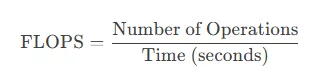
Formula:
Benchmarks:
- LINPACK: Measures real-world performance.
- Synthetic Tests: Stress-test hardware limits.
Key Factors:
- Processor Cores: More cores = more parallel operations.
- Memory Bandwidth: Faster data transfer = fewer bottlenecks.
- Clock Speed: Higher GHz = quicker individual calculations.
Evolution of FLOPS: From Mega to Exa
- 1970s: Cray-1 supercomputer (160 MFLOPS).
- 2025: Frontier Supercomputer (1.5 EFLOPS).
- Future: Quantum computing could make today’s FLOPS obsolete!
Did You Know? The human brain operates at ~1 exaflop, but uses far less energy than supercomputers.
FLOPS in Everyday Tech
- Gaming Consoles: PS6 (2025) may hit 100 TFLOPS for hyper-realistic graphics.
- Smartphones: Apple’s A18 chip uses FLOPS for real-time photo editing.
FAQs
Q: FLOPS vs. MIPS?
A: FLOPS measures decimal calculations; MIPS counts general instructions (like opening apps).
Q: Why do GPUs have higher FLOPS than CPUs?
A: GPUs have thousands of cores for parallel tasks—perfect for FLOPS-heavy AI.
Q: Does FLOPS affect battery life?
A: Yes! Higher FLOPS often mean more power use. Chipmakers like TSMC focus on efficiency.
The Future of FLOPS
By 2025, expect:
- Exascale Computing: 1 exaflop = 50,000 laptops combined!
- Neuromorphic Chips: Mimic the brain’s efficiency.
Quantum Leap: Quantum computers may solve problems in seconds that take supercomputers millennia.