Introduction
In the digital age, fiber optics has revolutionized how we transmit data, offering unmatched speed and reliability. By 2025, this technology will dominate global communication networks, powering everything from 5G internet to smart cities. Let’s dive into the world of fiber optics and explore its workings, types, uses, and future potential.
What is Fiber Optics?
Fiber optics is a cutting-edge technology that transmits data as light pulses through ultra-thin strands of glass or plastic. These strands, known as optical fibers, act as waveguides to carry information over long distances with minimal loss. Unlike traditional copper cables, fiber optics offer higher bandwidth, faster speeds, and immunity to electromagnetic interference, making them indispensable for modern telecommunications, healthcare, and defense systems.
Key Components of Fiber Optics
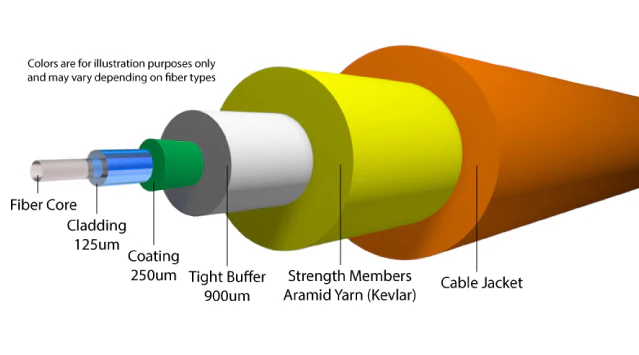
- Core:
- The innermost layer, made of glass/plastic, where light travels.
- Diameter: 5–100 micrometers (thinner than a human hair!).
- Cladding:
- Surrounds the core, with a lower refractive index to reflect light back into the core.
- Prevents signal loss via Total Internal Reflection (TIR).
- Buffer Coating:
- A protective plastic layer (250–300 µm thick) shielding the fiber from damage.
Types of Fiber Optics
1. Based on Modes of Light
- Single-Mode Fiber (SMF):
- Core Diameter: 5 µm.
- Uses: Long-distance communication (e.g., undersea cables).
- Advantages: Zero dispersion, high speed (up to 100 Gbps).
- Light Source: Laser diode.
- Multi-Mode Fiber (MMF):
- Core Diameter: 40–100 µm.
- Uses: Short-distance networks (e.g., LANs, data centers).
- Disadvantages: Signal degradation due to multiple light paths.
- Subtypes:
- Step-Index Fiber: Uniform core refractive index.
- Graded-Index Fiber: Gradually decreasing refractive index.
2. Based on Material
- Glass Fibers: High purity silica for minimal signal loss.
- Plastic Fibers (POF): Flexible, cost-effective, but limited to short distances.
How Does Fiber Optics Work?
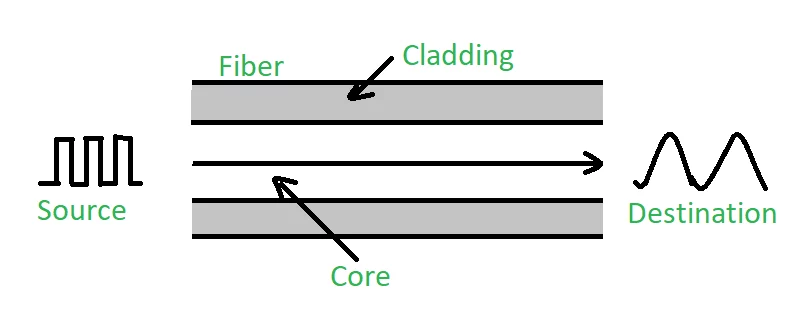
- Transmission: Data is converted into light pulses (photons) using LEDs/lasers.
- Propagation: Light travels through the core, bouncing off cladding via TIR.
- Reception: A photodetector converts light back to electrical signals.
Why It’s Efficient:
- Speed: Light travels at ~186,000 miles/sec.
- Bandwidth: Supports terabits per second (Tbps).
- Security: Difficult to tap without detection.
Applications of Fiber Optics in 2025
- Telecom & Internet:
- Powers 5G networks, FTTH (Fiber-to-the-Home), and cloud computing.
- Healthcare:
- Enables minimally invasive surgeries (endoscopes) and laser treatments.
- Military & Aerospace:
- Secure communication, missile guidance, and UAV operations.
- Smart Cities:
- Connects IoT devices, traffic systems, and surveillance networks.
Advantages of Fiber Optics
- Blazing Speeds: 1,000x faster than copper cables.
- Low Latency: Ideal for gaming, VR, and real-time trading.
- EMI Immunity: Unaffected by power lines or radio waves.
- Durability: Resists corrosion, temperature changes, and water.
Challenges in 2025
- High Costs: Installation expenses remain steep.
- Fragility: Glass fibers require careful handling.
- Skill Gap: Demand for specialized technicians.
FAQs
Q1: What are common fiber optic connectors?
A: ST, SC, LC, and MT-RJ (4 widely used types).
Q2: How secure is fiber optics?
A: Highly secure, but vulnerable to physical tapping or bending attacks.
Q3: Will wireless replace fiber optics?
A: No—wireless networks rely on fiber backbones for data transport.
Conclusion
By 2025, fiber optics will remain the cornerstone of global connectivity, driving innovations in AI, telemedicine, and beyond. While challenges like costs persist, its unparalleled speed and reliability ensure it stays ahead of copper and wireless alternatives.