Introduction
Introduction
In today’s tech-driven world, Integrated Circuits (ICs) are the unsung heroes powering everything from smartphones to spaceships. Often called microchips or simply chips, these tiny wonders have revolutionized electronics. Let’s dive into their world, exploring their types, functions, and future trends—all in simple, easy-to-grasp language.
What is an Integrated Circuit (IC)?
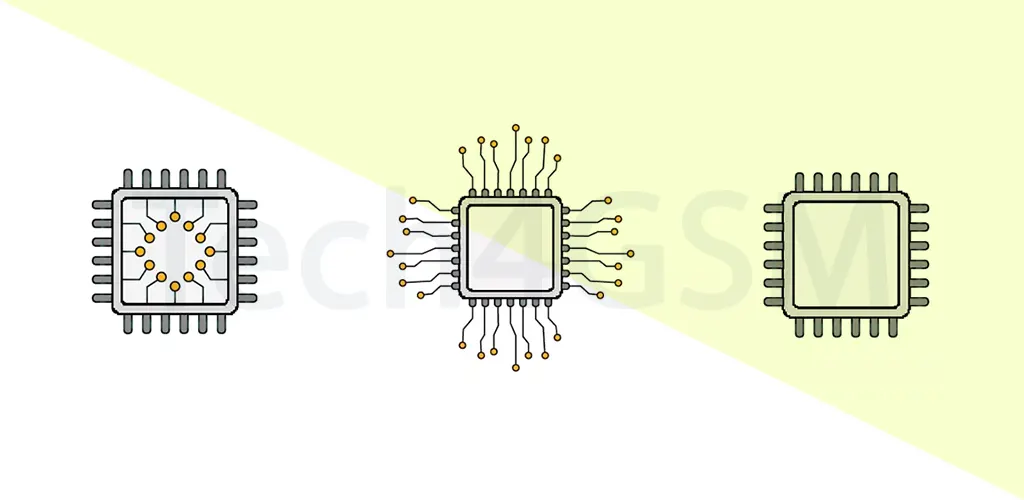
An Integrated Circuit (IC) is a miniaturized electronic circuit made by embedding components like transistors, resistors, and capacitors onto a single semiconductor material, usually silicon. Think of it as a microscopic city where each “building” (component) works together to perform complex tasks.
Key Points:
- Born from Innovation: Invented in 1947 by William B. Shockley’s team at Bell Labs, ICs evolved from the transistor’s discovery.
- Size Matters: Modern ICs can pack billions of components into a space smaller than a fingernail.
- Versatile Use: From amplifying signals (like in headphones) to running computer programs, ICs do it all.
How Are ICs Classified?
ICs come in three primary flavors, each with unique roles:
1. Digital Integrated Circuits
- Function: Process binary data (0s and 1s).
- Examples: Microprocessors, RAM, ROM, logic gates (AND, OR).
- Applications: Computers, smartphones, digital watches.
2. Analog Integrated Circuits
- Function: Handle continuous signals (e.g., sound, temperature).
- Examples: Op-amps, radio-frequency amplifiers.
- Applications: Audio equipment, sensors, power regulators.
3. Mixed-Signal ICs
- Function: Combine analog and digital circuits.
- Examples: Analog-to-digital converters (ADCs), microcontrollers.
- Applications: Smart devices, IoT gadgets, automotive systems.
Inside an IC: Construction & Design
Building an IC is like crafting a microscopic sculpture. Here’s how it’s done:
- Photolithography: A silicon wafer is coated with light-sensitive material and exposed to UV light through a stencil (mask).
- Etching: Unwanted material is chemically removed to create circuit patterns.
- Doping: Impurities are added to silicon to alter its electrical properties.
- Layering: Multiple layers of materials (metals, oxides) are stacked to form connections.
- Packaging: The chip is encased in plastic/ceramic, with pins for external connections.
Fun Fact: A single IC fabrication plant costs over $20 billion!
Why Are ICs So Important?
- Miniaturization: Replaced bulky vacuum tubes, enabling portable devices.
- Cost-Effective: Mass production slashes prices (e.g., a microcontroller costs less than a coffee).
- Reliability: Fewer soldered connections mean fewer failures.
- Speed: Signals travel faster in compact circuits (think GHz processors).
Did You Know? The average car contains over 1,000 ICs!
Advantages vs. Disadvantages of ICs
| Pros | Cons |
|---|---|
| Compact size | Fragile; hard to repair |
| Low power consumption | Limited high-power handling |
| High reliability | Can’t integrate inductors/coils |
| Mass production lowers cost | Sensitive to static electricity |
ICs in Action: Real-World Applications
- Logic Gates: Build decision-making circuits (e.g., traffic light controllers).
- Timers: The iconic 555 timer IC powers egg timers and LED flashers.
- Voltage Regulators: Keep your phone battery from overheating.
- Microcontrollers: Run your dishwasher, coffee maker, and even NASA rovers!
The Future of ICs: 2025 and Beyond
- Moore’s Law Lives On: Transistors will shrink further, with 2nm chips entering mass production.
- AI Integration: Chips designed for machine learning (e.g., NPUs) will dominate.
- Quantum Leap: Quantum ICs could solve problems in seconds that take supercomputers years.
- IoT Explosion: Smart homes and cities will demand ultra-low-power ICs.
Prediction: By 2025, ICs will drive breakthroughs in AI healthcare and climate modeling!
FAQ: Your IC Questions Answered
Q1: What’s the role of photolithography in IC manufacturing?
Photolithography “prints” circuit patterns onto silicon using light, like a microscopic stencil.
Q2: Name two IC functions.
ICs act as amplifiers (boost signals) and microprocessors (run software).
Q3: What components are inside an IC?
Transistors, resistors, capacitors, diodes, and interconnecting wires.
Conclusion
Integrated Circuits are the silent engines of the digital age, making modern life possible. As we march into 2025, expect smarter, faster, and greener ICs to reshape industries.
Final Thought: Next time you use a device, remember—there’s a tiny IC working tirelessly inside!