Introduction
Think of your SIM card as your phone’s passport—it holds your identity, keeps your calls secure, and lets you hop between devices effortlessly. Let’s dive into the world of these tiny chips and uncover their secrets!
1. What’s a SIM Card? Your Digital ID
A Subscriber Identity Module (SIM) is a removable smart card that slots into your phone. It does two big jobs:
- Identifies You: Stores your unique customer ID, phone number, and network details.
- Encrypts Calls: Uses voice encryption to block eavesdroppers (unless your carrier’s involved!).
Best part? Your number is tied to the SIM, not the phone. Swap it into another GSM phone, and you’re good to go!
2. SIM Cards: More Than Just a Number
Besides your ID, SIMs store:
- Contacts: Up to 250 names/numbers (but no multiple numbers per contact—it splits them into separate entries).
- Texts: Holds around 50 SMS messages.
⚠️ Warning: Copying contacts from your phone to SIM? Say goodbye to extra details like emails or birthdays—SIMs only save basics!
3. “Does My Phone Need a SIM?” It Depends!
- GSM & iDEN Phones: Require a SIM card.
- CDMA, TDMA, AMPS Phones: No SIM! Data is programmed directly into the device.
Fun fact: Most modern phones (even CDMA ones) now use SIMs for 4G/5G networks.
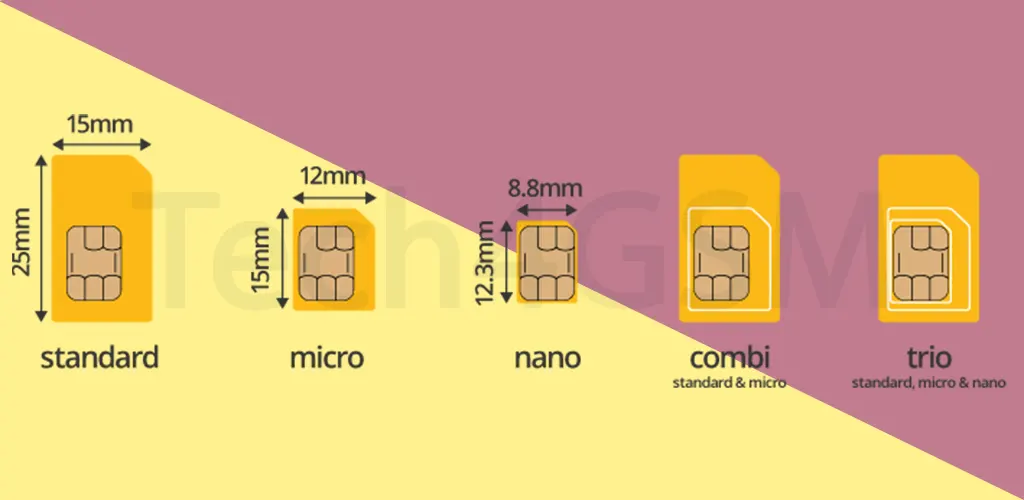
4. SIM Card Sizes: From Credit Card to Invisible Chip
Over the years, SIMs shrunk to save space in slimmer phones:
- Full-Size (1FF): Credit-card-sized (85.6mm x 53.98mm). Ancient history now!
- Mini-SIM (2FF): Smaller (25mm x 15mm) with a cut corner. Think 2000s flip phones.
- Micro-SIM (3FF): Trimmed to 15mm x 12mm. Popular in early smartphones.
- Nano-SIM (4FF): Tiny (12.3mm x 8.8mm). Used in most phones today.
- eSIM: Soldered onto the motherboard (6mm x 5mm). No swapping—just scan a QR code!
💡 Pro Tip: Use adapters to fit smaller SIMs into larger slots (e.g., nano-SIM in a micro-SIM tray).
5. Security: PINs, PUKs, and “Oops, I’m Locked Out!”
Your SIM has two secret codes:
- PIN (Personal Identification Number): Unlocks the SIM. Three wrong guesses? It locks!
- PUK (Personal Unblocking Key): Resets a locked PIN. 10 wrong PUK attempts = SIM destroyed forever.
🔒 Safety Hack: Turn off PIN requests in settings if typing it every time annoys you (but stay cautious!).
6. The Future: eSIMs Are Here!
Embedded SIMs (eSIMs) ditch the physical card. Instead:
- Built into the phone.
- Switch carriers via software (no store visits!).
- Perfect for smartwatches, tablets, and travel-friendly phones.
Conclusion: Small Chip, Big Power
From bulky plastic to invisible tech, SIM cards keep us connected—securely and flexibly. Next time you switch phones, thank that little chip for making it effortless!