Introduction
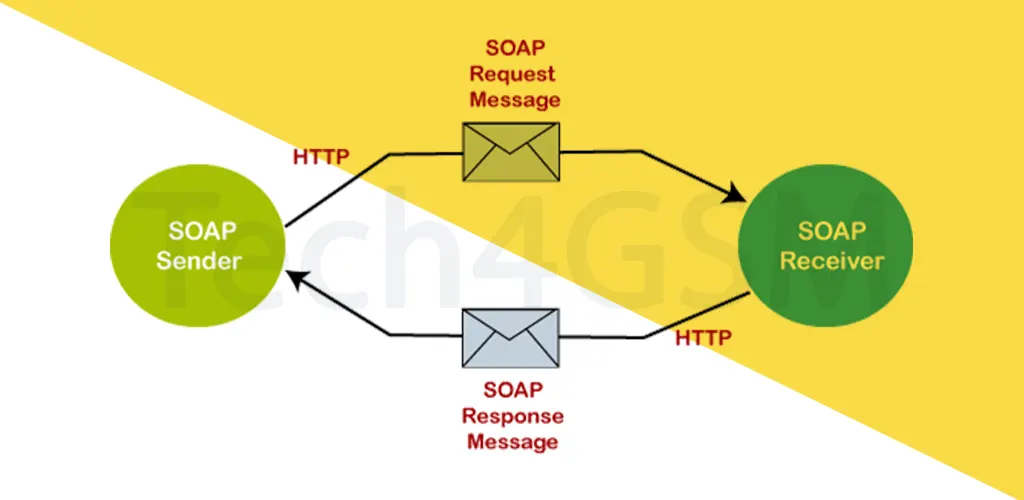
SOAP (Simple Object Access Protocol) is a network protocol that allows different systems to exchange structured data seamlessly. Imagine it as a universal translator that helps apps, servers, and devices communicate—even if they’re built using different programming languages or run on separate operating systems. Let’s break down how SOAP works, its structure, and why it’s still relevant in 2025.
What is SOAP?
SOAP is a messaging protocol that uses XML (Extensible Markup Language) to transfer data. Here’s why it stands out:
- Platform Independent: Works across Windows, Linux, macOS, etc.
- Language Agnostic: Compatible with Java, Python, C#, and more.
- Reliable: Built on HTTP/HTTPS or SMTP, which are widely supported.
- History: Created in 1998 by Microsoft engineers (Bob Atkinson, Don Box, Dave Winer, Mohsen Al-Ghosein) and later managed by the World Wide Web Consortium (W3C) until 2009.
How Does a SOAP Message Look?
Every SOAP message is an XML document with four key parts:
- Envelope (Mandatory):
- Acts like a wrapper, indicating it’s a SOAP message.
- Contains the Header and Body.
- Header (Optional):
- Carries extra details like authentication or routing info.
- Body (Mandatory):
- Holds the actual request or response data.
- Includes Fault section if there’s an error.
- Fault (Optional):
- Explains errors (e.g., “Invalid request” or “Server down”).
Example of a SOAP Message
Content-Type: application/soap+xml
<env:Envelope xmlns:env="http://www.w3.org/2003/05/soap-envelope">
  <env:Header>
    <m:GetLastTradePrice xmlns:m="Some-URI" />
  </env:Header>
  <env:Body>
    <symbol xmlns:p="Some-URI">DIS</symbol>
  </env:Body>
</env:Envelope>
- Envelope: Defines the XML namespace.
- Header: Requests the last trade price.
- Body: Contains the stock symbol “DIS”.
Top 5 Advantages of SOAP
- Lightweight: Uses XML for simple, structured data transfer.
- Universal Compatibility: Runs on any OS or platform.
- HTTP-Based: Leverages existing web infrastructure.
- Security: Supports WS-Security for encryption.
- Official Standard: Backed by W3C, ensuring reliability.
SOAP is widely used in enterprise web services, banking systems, and APIs where accuracy matters. Learn more about APIs at tech4gsm.com.
FAQs About SOAP
1. Is SOAP still used in 2025?
Yes! It’s preferred in industries like healthcare and finance for secure, error-proof messaging.
2. SOAP vs. REST: Which is better?
- SOAP: Better for complex transactions (e.g., payments).
- REST: Simpler, ideal for mobile/web apps.
3. Why does SOAP use XML?
XML ensures data is self-describing and structured, reducing misinterpretation.
4. Can SOAP work without HTTP?
Yes, it can use SMTP (email protocol) too!
5. How does SOAP handle errors?
Through the Fault section, which details error codes and messages.
Final Thoughts
SOAP remains a robust choice for mission-critical systems in 2025. Its strict standards and compatibility make it ideal for scenarios where data integrity is non-negotiable.