Introduction
Binary Coded Decimal (BCD) is a clever way computers handle decimal numbers by converting each digit into a 4-bit binary code. Unlike regular binary, which converts the whole number, BCD treats each digit separately—making it perfect for systems like calculators and digital clocks. Let’s break down how BCD works and why it’s still relevant in 2025.
Key Takeaways
- BCD = Decimal made digital: Each digit (0-9) becomes a 4-bit code.
- Human-friendly: Ideal for displays like clocks, meters, and calculators.
- Simplifies decimal math: No complex conversions—just direct digit handling.
- 2025 applications: Embedded systems, IoT devices, and financial tech.
What is BCD?
Imagine writing the number “25” as 0010 0101 instead of binary’s “11001.” That’s BCD! Each decimal digit is converted to a 4-bit binary chunk:
- 0 → 0000
- 5 → 0101
- 9 → 1001
Why use BCD?
- Accuracy: No rounding errors in decimal calculations.
- Clarity: Easier to display numbers on screens (e.g., digital clocks).
How BCD Works
Step 1: Decimal to BCD
Convert each digit of a decimal number to 4-bit binary:
- 57 → 0101 (5) + 0111 (7) = 0101 0111.
Step 2: Arithmetic Operations
BCD uses special rules for math:
- Addition: If a digit exceeds 9, add 6 (0110) to correct.
Example: 7 + 5 = 12 → Add 6 to get 0001 0010 (12). - Subtraction: If borrowing is needed, adjust with 6.
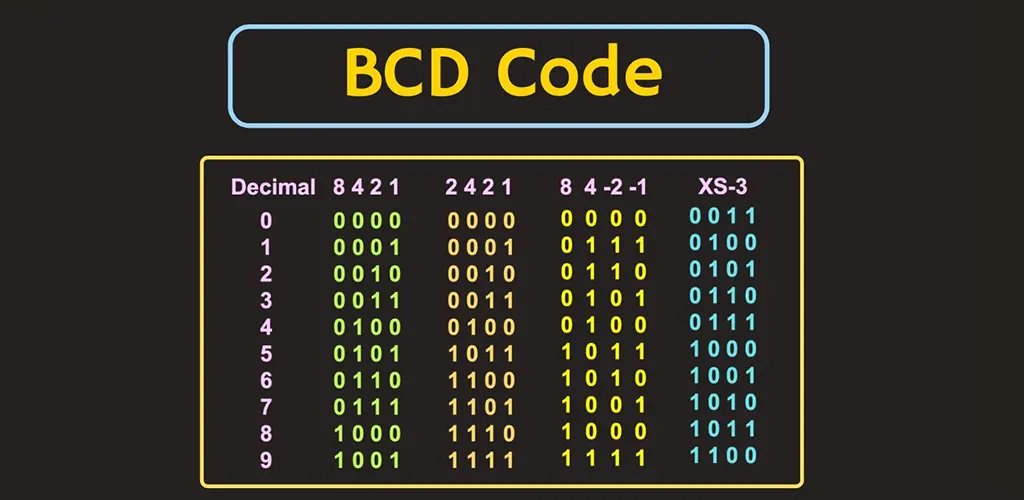
The Binary Coded Decimal (BCD) system uses 4-bit binary codes to represent each decimal digit (0-9). Here’s a simple truth table showing how it works:
| Decimal | BCD (4-bit) |
|---|---|
| 0 | 0000 |
| 1 | 0001 |
| 2 | 0010 |
| 3 | 0011 |
| 4 | 0100 |
| 5 | 0101 |
| 6 | 0110 |
| 7 | 0111 |
| 8 | 1000 |
| 9 | 1001 |
Key Points to Remember
- 4 Bits per Digit: Each decimal digit (0-9) gets a unique 4-bit code.
- No Wasted Codes: Only 0-9 are valid—codes like 1010 (10) or 1111 (15) are invalid in BCD.
- Easy Conversion: To convert a multi-digit number (e.g., 25), split it into 2 and 5, then use their BCD codes:
- 2 → 0010
- 5 → 0101
- 25 → 0010 0101.
Why 4 Bits?
- Simplicity: 4 bits perfectly cover 0-9 (no extra bits needed).
- Error Prevention: Invalid codes (1010 to 1111) alert systems to mistakes.
Example Use Case
A digital clock displays 09:45 using BCD:
- 0 → 0000 | 9 → 1001 | 4 → 0100 | 5 → 0101.
Packed vs. Unpacked BCD
| Type | Packed BCD | Unpacked BCD |
|---|---|---|
| Storage | Two digits per byte (e.g., 93 → 1001 0011). | One digit per byte (e.g., 9 → 0000 1001). |
| Efficiency | Saves memory. | Easier to process individual digits. |
| Use Case | High-speed systems. | Simple displays or data entry. |
Limitations of BCD
- Memory Hog: Uses more space than pure binary.
- Slower Math: Extra steps for corrections.
- No Fractions: Limited to whole numbers.
- Hardware Costs: Needs specialized chips.
Where BCD Shines in 2025
- Digital Displays: Clocks, calculators, and dashboards.
- Embedded Systems: Medical devices, IoT sensors.
- Financial Systems: Precise decimal calculations for banking.
- Retail Tech: Barcode scanners and inventory trackers.
Pro Tip: Use BCD when accuracy matters more than speed.
BCD vs. Regular Binary
| Aspect | BCD | Binary |
|---|---|---|
| Decimal Handling | Each digit processed separately. | Whole number converted to binary. |
| Speed | Slower (needs corrections). | Faster. |
| Use Case | Human-readable outputs. | High-speed computing. |
FAQs
Q: Can BCD handle negative numbers?
A: Yes! Use a sign bit (e.g., 1100 for “-12”).
Q: Why not use hexadecimal?
A: BCD avoids hex’s letters (A-F), keeping numbers human-friendly.
Q: Is BCD outdated?
A: Not at all! It’s vital in 2025 for IoT and edge computing.
Q: How to convert BCD to decimal?
A: Split the 4-bit chunks and map them to 0-9.
Future of BCD
In 2025, BCD stays relevant for:
- Legacy Systems: Upgrading old hardware without redesigns.
- Precision Tech: Robotics and AI needing exact decimal math.
- Energy Efficiency: Low-power devices where simplicity saves battery.
Conclusion
BCD bridges the gap between human-friendly decimals and machine-readable binary. While not perfect for every task, it’s unbeatable for accuracy in displays and embedded systems.
BCD: Where simplicity meets precision! 🔢