Introduction
A coaxial cable (often called “coax”) is a guided media used to transmit electrical signals with minimal interference. Made of copper, plastic, and insulating layers, it’s widely used for TV, internet, CCTV, and telecommunications. Despite competition from fiber optics, coaxial cables remain vital in 2025 due to their reliability, affordability, and ease of installation.
Structure of Coaxial Cables
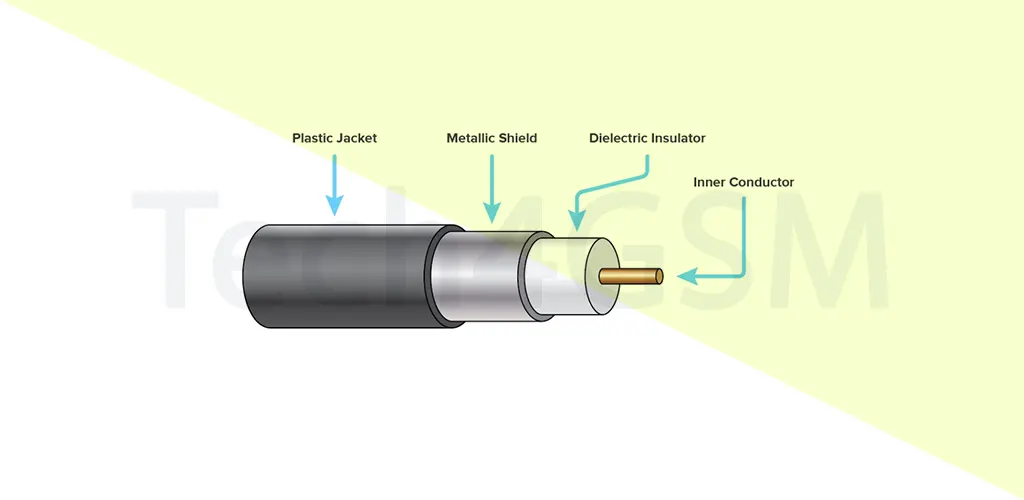
Coaxial cables have a unique layered design that ensures signal integrity and noise resistance:
- Copper Core: Central conductor that carries electrical signals.
- Dielectric Insulator: Plastic layer around the core to prevent signal leakage.
- Braided Mesh: Metal shield (usually copper or aluminum) blocking electromagnetic interference (EMI).
- Outer Jacket: Protective plastic coating for durability.
How Do Coaxial Cables Work?
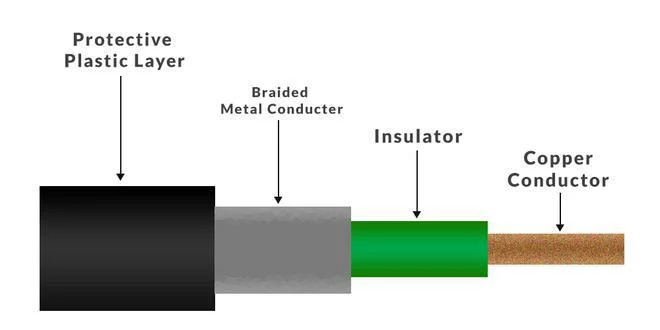
Coaxial cables transmit signals through their central copper core, while the braided shield blocks external interference. Here’s a simple breakdown:
- Signal Transmission: Electrical signals travel through the copper core.
- Noise Cancellation: The braided mesh absorbs EMI (e.g., from power lines or Wi-Fi routers).
- Insulation: The dielectric layer keeps the core and shield separated, preventing short circuits.
This design makes coax ideal for high-frequency applications like broadband internet and HDTV.
Types of Coaxial Cables
| Type | Best For | Key Features |
|---|---|---|
| RG-6 | Cable TV, Internet | Thicker core, quad shielding, 18 GHz+ |
| RG-59 | CCTV, Short-distance video | Thinner, affordable, up to 2 GHz |
| RG-11 | Long-distance HDTV | Low signal loss, spans 600+ meters |
| Hardline | Broadcast towers, military | Solid copper core, ultra-low attenuation |
| Triaxial (Triax) | Medical imaging, aerospace | Extra shield layer for extreme noise protection |
Coaxial Cable Connectors
- BNC (Bayonet Neill-Concelman):
- Used in TVs, radios, and test equipment (up to 4 GHz).
- Easy “push-and-twist” locking mechanism.
- F-Type:
- Common for cable TV and modems.
- Screw-on design for RG-6/RG-59 cables.
- SMA (SubMiniature A):
- High-frequency uses like Wi-Fi antennas (up to 18 GHz).
- RCA:
- Classic audio/video jacks (red/white/yellow).
Top Uses of Coaxial Cables in 2025
- Broadband Internet:
- RG-6 cables deliver high-speed internet via cable modems.
- Faster than DSL, cheaper than fiber in rural areas.
- HDTV and Satellite TV:
- RG-11 ensures 4K/8K signal quality over long distances.
- CCTV Security Systems:
- RG-59 for short-range cameras, RG-6 for high-resolution feeds.
- Medical Equipment:
- Triaxial cables in MRI machines and ultrasound devices.
- Military Communications:
- Hardline coax for secure, interference-free data transfer.
Advantages of Coaxial Cables
- ✅ High Bandwidth: Supports up to 10 Gbps (with DOCSIS 4.0).
- ✅ Durability: Resists cuts, weather, and EMI.
- ✅ Easy Installation: No specialized tools needed.
- ✅ Cost-Effective: Cheaper than fiber for short distances.
- ✅ Legacy Compatibility: Works with older TVs and routers.
Disadvantages of Coaxial Cables
- ❌ Signal Loss: Degrades over long distances (fixed with amplifiers).
- ❌ Bulky Design: Hard to bend in tight spaces.
- ❌ Security Risks: Vulnerable to “tapping” if poorly shielded.
- ❌ Limited Speed: Fiber optics offer faster speeds (100 Gbps+).
Coaxial vs. Fiber Optics: Key Differences
| Feature | Coaxial Cable | Optical Fiber |
|---|---|---|
| Signal Type | Electrical | Light |
| Speed | Up to 10 Gbps | Up to 100+ Tbps |
| Distance | ~500 meters | 40+ kilometers |
| Cost | Affordable | Expensive |
| Weight | Heavy | Lightweight |
| 2025 Use Cases | Home internet, CCTV | Data centers, 5G networks |
Troubleshooting Coaxial Cable Issues
- Signal Loss:
- Use amplifiers or replace old cables with RG-6/RG-11.
- Interference:
- Ensure connectors are tight; upgrade to quad-shielded cables.
- Physical Damage:
- Inspect for cuts or corrosion; waterproof outdoor cables.
Future of Coaxial Cables in 2025
- DOCSIS 4.0:
- Delivers 10 Gbps speeds over existing coax networks.
- 5G Integration:
- Coaxial cables support small-cell 5G antennas in urban areas.
- Smart Home Compatibility:
- Coax-based MoCA adapters for 4K streaming and smart hubs.
FAQs About Coaxial Cables
Q1: Can coaxial cables carry internet and TV simultaneously?
A: Yes! Splitters divide signals between modems and TVs without speed loss.
Q2: Why is RG-6 better than RG-59?
A: RG-6 has thicker shielding and handles higher frequencies (ideal for 4K/8K).
Q3: How long do coaxial cables last?
A: Up to 20 years if shielded from moisture and physical damage.
Q4: Are coaxial cables obsolete with fiber optics?
A: No! Coax is still used in 75% of U.S. homes for internet/TV (2025 data).
Q5: Can I run coaxial cables alongside power lines?
A: Avoid it! Power lines cause EMI—keep at least 12 inches apart.
Q6: What’s the max speed of coaxial internet?
A: 10 Gbps with DOCSIS 4.0—matching basic fiber plans.
Conclusion
Coaxial cables are the unsung heroes of modern connectivity. From delivering Netflix binges to securing airports with CCTV, they balance performance, cost, and reliability. While fiber optics dominate high-speed niches, coaxial technology evolves with DOCSIS 4.0 and 5G integration, ensuring its relevance in 2025 and beyond.