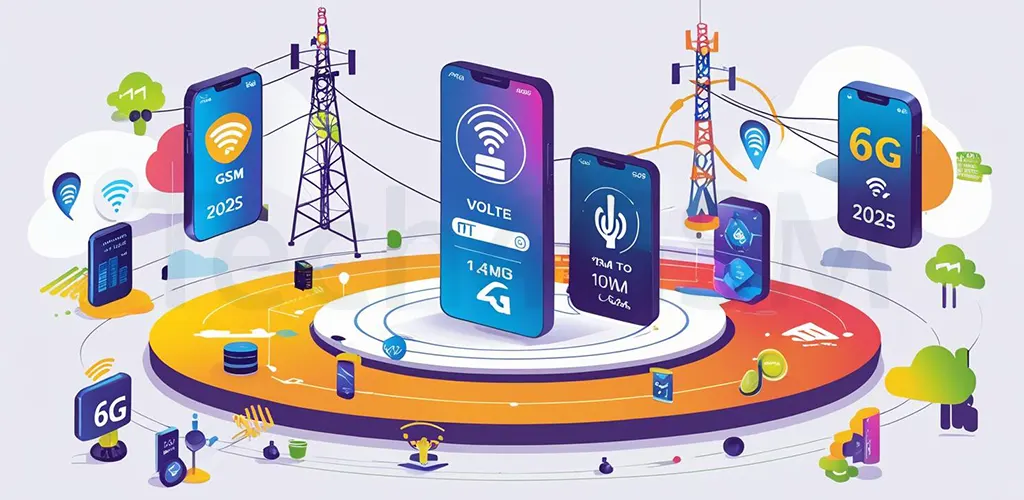
Latest Innovations in GSM Technology: From VoLTE to 6G Rumors
The world of wireless communication has come a long way since the early days of 2G. Today, as 5G networks deliver faster speeds and lower latency, the tech industry is already buzzing about 6G. But before we dive into the future, let’s appreciate how far we’ve come—starting with VoLTE.
Voice over LTE (VoLTE) revolutionized voice calls by transmitting them over 4G networks, offering crystal-clear audio and faster call setup times. Now, with 5G-Advanced bridging the gap to 6G, the next generation of wireless tech promises to redefine connectivity. Let’s explore the journey from VoLTE to the thrilling possibilities of 6G.
5G-Advanced: The Stepping Stone to 6G
While 5G is still rolling out globally, 5G-Advanced—a series of upgrades—is already enhancing network efficiency and capabilities. Think of it as a software update for 5G, improving energy efficiency, coverage, and support for IoT devices. However, the real excitement lies in 6G, which aims to merge the physical and digital worlds seamlessly.
What Is 6G, and Why Does It Matter?
6G isn’t just about faster speeds. It’s a transformative leap that could reshape industries, enable smart cities, and even address global challenges like sustainability. Experts predict 6G will combine three groundbreaking technologies:
- Joint Communication and Sensing (JCAS): Giving devices “eyes” to sense their surroundings using wireless signals.
- Zero Energy Communication (ZEC): Devices that harvest energy from ambient signals, eliminating batteries.
- AI-Driven Networks: Machines learning in real-time to optimize performance.
Let’s break these down.
Game-Changer #1: Joint Communication and Sensing (JCAS)
Imagine your smartphone detecting a nearby wall or a self-driving car sensing pedestrians without cameras. JCAS uses wireless signals (like Wi-Fi or cellular waves) to map environments. This reduces reliance on bulky sensors and could revolutionize traffic management, smart homes, and even healthcare.
How It Works: When a signal bounces off objects, devices analyze the reflections to determine distance, speed, and material. For example, a JCAS-enabled router could track motion in a room, turning lights on/off automatically.
Game-Changer #2: Zero Energy Communication (ZEC)
What if your smartwatch never needed charging? ZEC devices harvest energy from radio waves, sunlight, or heat. This innovation is critical for IoT sensors in remote areas (e.g., forest fire detectors) or medical implants.
The Science: New 6G waveforms will transmit data and energy simultaneously. Think of it like solar panels—but for wireless signals. Tech4GSM reports that early prototypes can power sensors using signals from drones!
Game-Changer #3: AI-Powered Networks
6G will rely on AI to manage its complexity. Instead of pre-programmed rules, networks will learn and adapt. For instance, AI could reroute traffic during a concert or predict hardware failures before they happen.
Real-World Impact:
- Smart Factories: Machines communicating in real-time to prevent downtime.
- Personalized Connectivity: Your phone prioritizing bandwidth for video calls over app updates.
CableLabs and the Race to 6G
CableLabs, a leader in telecom R&D, is collaborating with global standards bodies like 3GPP to shape 6G. Their focus includes:
- Seamless Convergence: Blending Wi-Fi, cellular, and satellite networks.
- Sustainability: Reducing energy use in data-heavy networks.
By 2030, CableLabs envisions 6G enabling holographic calls, autonomous drones, and smart grids that cut carbon emissions.
Wi-Fi Spectrum Crisis: A Warning Sign
While 6G is futuristic, today’s Wi-Fi networks are struggling. A 2025 study by CableLabs warns that the 6 GHz band—crucial for high-speed Wi-Fi—is nearing exhaustion due to exploding device demand.
The Problem:
- In crowded apartments, users face laggy video calls and dropped connections.
- Without new spectrum, latency could spike by 10 milliseconds, ruining real-time apps.
The Solution: Policymakers must allocate more unlicensed spectrum. Reallocating 6 GHz for other uses would cripple Wi-Fi-dependent industries like telehealth and online education.
The Road Ahead
From VoLTE to 6G, each generation of GSM tech solves old challenges and unlocks new possibilities. While 6G’s full potential is years away, its foundation is being laid today. Innovations like JCAS, ZEC, and AI networks promise a future where connectivity is seamless, sustainable, and smarter than ever.
As we await 6G’s arrival in 2030, one thing is clear: The future of wireless isn’t just about speed—it’s about transforming how we live, work, and interact with the world.
Comparison Table: Latest Innovations in GSM Technology (VoLTE to 6G Rumors in 2025)
The transition from 5G to 6G involves groundbreaking strategies to enhance speed, reliability, and sustainability. Below, we compare key aspects of 5G and 6G deployments, drawing lessons from past migrations and highlighting future-ready innovations.
| Feature | 5G Networks | 6G Networks (2025 Outlook) |
|---|---|---|
| Deployment Strategy | Used Non-Standalone (NSA) mode initially, relying on 4G infrastructure. Later shifted to Standalone (SA) for full capabilities. | Prioritizes 6G SA from Day 1 to avoid fragmentation. Focuses on AI-driven, cloud-native networks without legacy dependencies. |
| Spectrum Use | Combined 4G and 5G bands via dual connectivity. Limited dynamic sharing. | Uses Multi-RAT Spectrum Sharing (MRSS) to reuse 5G bands for 6G. Adds terahertz (THz) frequencies for ultra-high capacity. |
| Infrastructure Reuse | Required hardware upgrades for 5G RAN. Partial reuse of 4G towers. | Hardware pooling allows 5G radios to support 6G. Focuses on software updates over hardware swaps. |
| Key Technologies | VoLTE, Massive MIMO, mmWave. | AI-native air interface, zero-energy devices, RF sensing, and holographic communications. |
| User Experience | 1 Gbps speeds, 5ms latency. Limited IoT scalability. | 1 Tbps speeds, 0.1ms latency. Supports 10M devices/km² for smart cities. |
| Migration Challenges | Delayed SA adoption caused fragmented ecosystems. | Balancing new spectrum needs with 5G legacy. Ensuring global SA standards. |
| Sustainability | Moderate energy efficiency improvements. | AI optimizes energy use. Zero-energy IoT devices reduce e-waste. |
| Backward Compatibility | Required 4G interworking, complicating upgrades. | Dual-Stack devices run 5G/6G independently, simplifying transitions. |
Key Takeaways
- 6G Prioritizes Standalone (SA): Unlike 5G’s phased NSA approach, 6G SA avoids ecosystem splits and accelerates AI-driven services.
- Spectrum Sharing Evolves: MRSS lets 6G coexist with 5G, while THz bands unlock unprecedented speeds.
- Hardware Pooling Cuts Costs: Reusing 5G infrastructure (e.g., radio units) extends ROI and supports greener networks.
- Dual-Stack Devices: Phones with separate 5G/6G stacks ensure seamless connectivity during migration.
Summary
- VoLTE laid the groundwork for high-quality voice calls over 4G/5G.
- 5G-Advanced is enhancing today’s networks while paving the way for 6G.
- JCAS turns signals into “eyes” for devices, enabling smarter environments.
- ZEC could eliminate batteries by harvesting energy from wireless waves.
- AI-Driven 6G will self-optimize, making networks faster and more reliable.
- Wi-Fi’s 6 GHz band is at risk—without action, connectivity will suffer.
- 6G SA avoids past mistakes by ditching reliance on older networks.
- MRSS dynamically shares spectrum between 5G and 6G without service drops.
- Zero-Energy Devices in 6G could eliminate batteries for IoT sensors.
- Dual-Stack Phones bridge 5G and 6G, ensuring no user left behind.