
Introduction
JavaScript is the dynamic programming language that breathes life into websites. While HTML structures and CSS styles, JavaScript adds interactivity—clicking buttons, form validations, animations, and more. It’s lightweight, cross-platform, and runs directly in browsers without extra software.
Key Highlights:
- Client-Side Execution: Runs in browsers (Chrome, Firefox) via built-in interpreters.
- Server-Side Power: With Node.js, JavaScript handles backend tasks like database access.
- Versatility: Build websites, mobile apps (React Native), games (Phaser), and even machine learning models (TensorFlow.js).
Hello World in JavaScript
Start coding instantly with this free example:
console.log("Hello World!");
Output:
Hello World!
Try It Yourself: Use browser consoles (F12) or online editors like CodePen.
Why Learn JavaScript in 2025?
- Universal Demand: Over 97% of websites use JavaScript.
- Full-Stack Capability: Master React (frontend) and Node.js (backend).
- AI & Machine Learning: Develop ML models with TensorFlow.js.
- High Salaries: Average ₹8,00,000/year in India, $95,000/year globally.
JavaScript Fundamentals
1. Variables & Data Types
- Variables:
let,const,var(avoid). - Data Types: String, Number, Boolean, Object, Null, Undefined.
2. Operators
- Arithmetic:
+,-,* - Comparison:
==,===,> - Logical:
&&,||,!
3. Control Flow
- Conditionals:
if-else,switch - Loops:
for,while,do-while
Functions & Events
Functions
- Reusable Blocks:
function greet(name) {
  return `Hello, ${name}!`;
}
- Arrow Functions:
const greet = (name) => `Hello, ${name}!`;
Events
- Common Events:
onclick,onload,onkeypress. - Event Handling:
button.addEventListener('click', () => alert('Clicked!'));
Key Concepts:
- Hoisting: Variables/functions are accessible before declaration.
- Closures: Functions retaining access to outer scope.
- Event Bubbling: Events propagate from child to parent elements.
JavaScript Beginner Projects
- Counter App: Increment/decrement numbers.
- Password Toggle: Show/hide passwords.
- Palindrome Checker: Detect reverse strings.
- Random Password Generator: Mix letters, numbers, symbols.
Code Snippet (Counter):
let count = 0;
function updateCounter() {
  document.getElementById('count').textContent = count;
}
Data Structures in JavaScript
- Arrays:
let fruits = ['Apple', 'Banana']; - Objects:
let user = { name: 'John', age: 30 };
- Advanced Structures:
- Map: Key-value pairs.
- Stack: LIFO principle.
- Queue: FIFO principle.
Object-Oriented Programming (OOP)
- Classes & Objects:
class Car {
  constructor(brand) { this.brand = brand; }
}
- Inheritance:
class ElectricCar extends Car {
  constructor(brand, range) {
    super(brand);
    this.range = range;
  }
}
OOP Concepts: Encapsulation, Abstraction, Polymorphism.
DOM Manipulation
- Select Elements:
document.querySelector('#header');
- Modify Content:
element.innerHTML = '<h1>New Title</h1>';
- Event Listeners:
button.addEventListener('click', handleClick);
Asynchronous JavaScript
- Callbacks:
fetchData(url, (data) => console.log(data));
- Promises:
fetch(url)
  .then(response => response.json())
  .then(data => console.log(data));
- Async/Await:
async function getData() {
  const response = await fetch(url);
  const data = await response.json();
  return data;
}
Intermediate Projects
- Expense Tracker: Manage income/expenses.
- Quiz App with Timer: Multiple-choice questions.
- Dynamic Resume Builder: PDF generator.
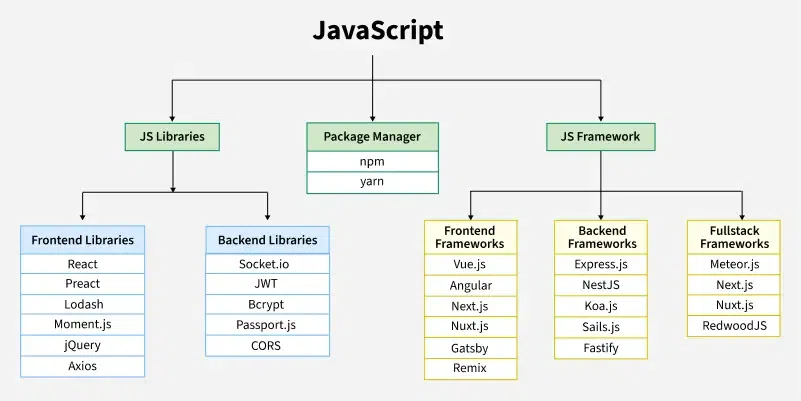
JavaScript Libraries & Frameworks
- Frontend: React, Angular, Vue.js.
- Backend: Node.js, Express.js.
- Mobile: React Native, Ionic.
JavaScript vs. Python vs. C++ vs. Java: A 2025 Comparison
| Feature | JavaScript | Python | C++ | Java |
|---|---|---|---|---|
| Type | Interpreted | Interpreted | Compiled | Compiled and Interpreted (JVM) |
| Paradigm | Multi-paradigm (event-driven, functional, OOP) | Multi-paradigm (OOP, procedural, functional) | Multi-paradigm (procedural, OOP, generic) | Object-Oriented, Structured |
| Memory Management | Automatic (Garbage Collection) | Automatic (Garbage Collection) | Manual | Automatic (Garbage Collection) |
| Syntax | Simple, flexible | Simple, readable | Complex, strict | Verbose, structured |
| Use Cases | Web dev, mobile apps, real-time apps | Web dev, data science, ML/AI | System programming, game dev, embedded systems | Enterprise software, Android apps, big data |
| Frameworks/Libraries | React, Angular, Node.js, Express.js | Django, Flask, TensorFlow, Pandas | Standard Library, Boost, Qt | Spring, Hibernate, Apache Spark |
| Community Support | Massive, active | Massive, beginner-friendly | Strong, niche-focused | Strong, enterprise-focused |
| Job Market | High demand (frontend/backend roles) | High demand (data/ML roles) | Moderate (system-level roles) | High demand (enterprise/Android roles) |
Key Takeaways
- JavaScript: Best for web and real-time apps (frontend/backend).
- Python: Ideal for data science, automation, and ML.
- C++: Perfect for high-performance systems and game engines.
- Java: Dominates enterprise software and Android development.
Top Companies Using JavaScript in 2025
| Company | How They Use JavaScript |
|---|---|
| Powers dynamic features in Gmail, Google Maps, and Chrome with JavaScript for real-time updates. | |
| Built its front-end with React (a JS library) for seamless UI interactions and performance. | |
| Netflix | Uses JavaScript for interactive UI and server-side optimizations via Node.js. |
| Airbnb | Combines React (front-end) and Node.js (back-end) for scalable booking platforms. |
| Employs JavaScript for real-time notifications and data-driven front-end interfaces. | |
| Uber | Relies on JavaScript for real-time ride tracking, routing algorithms, and driver-passenger apps. |
| Uses JavaScript to manage dynamic feeds, trending topics, and user interactions. | |
| PayPal | Leverages JavaScript for secure payment gateways and smooth checkout experiences. |
| eBay | Builds responsive web apps with JavaScript to handle auctions, listings, and user dashboards. |
| Slack | Powers real-time messaging and collaboration tools using JavaScript and WebSocket APIs. |
Why Do These Companies Use JavaScript?
- Versatility: Front-end (React) to back-end (Node.js) capabilities.
- Real-Time Features: Ideal for live updates in apps like Uber and Slack.
- Scalability: Node.js handles high traffic (e.g., Netflix, Airbnb).
- Community Support: Massive ecosystem of libraries (React, Angular) and frameworks.
JavaScript Career Paths & Salaries (2025)
| Career | Average Salary (INR) | Average Salary (USD) |
|---|---|---|
| JavaScript Developer | ₹5,00,000 – ₹12,00,000 | 60,000–110,000 |
| Front-End Developer | ₹6,00,000 – ₹14,00,000 | 65,000–120,000 |
| Full Stack Developer | ₹7,00,000 – ₹15,00,000 | 75,000–130,000 |
| Back-End Developer | ₹6,00,000 – ₹13,00,000 | 70,000–125,000 |
| Web Developer | ₹5,00,000 – ₹12,00,000 | 55,000–100,000 |
| React Developer | ₹6,00,000 – ₹13,00,000 | 70,000–125,000 |
| Node.js Developer | ₹7,00,000 – ₹16,00,000 | 75,000–135,000 |
| UX/UI Designer | ₹6,00,000 – ₹13,00,000 | 65,000–120,000 |
| Software Engineer | ₹5,00,000 – ₹15,00,000 | 65,000–120,000 |
Key Takeaways
- Highest Earners: Node.js and Full Stack Developers dominate the upper salary brackets.
- Global Demand: React and Node.js specialists are highly sought-after in the US and EU markets.
- Entry-Level Roles: Web Developers and JavaScript Developers offer accessible entry points for beginners.
- Hybrid Roles: UX/UI Designers with JS skills bridge design and functionality for better pay.
FAQs
Q1. Is JavaScript only for web development?
No! It’s used in mobile apps, servers (Node.js), games, and IoT.
Q2. How long to learn JavaScript?
Basics in 2–3 weeks; mastery requires 6–12 months with projects.
Q3. What’s new in JavaScript 2025?
Enhanced ES2025 features like pattern matching and faster execution.
Start Your Journey Today!
With endless possibilities, JavaScript is your gateway to tech innovation.