Introduction
You might be surprised to know that the internet’s origin story begins with a project called ARPANET. Short for Advanced Research Projects Agency Network, ARPANET was the first-ever network to use distributed control and TCP/IP protocols—the same tech that powers today’s internet. Designed to let scientists and universities share data seamlessly, it laid the foundation for the digital world we rely on in 2025. Let’s break down its history, features, and legacy in simple terms.
History of ARPANET: How It All Began
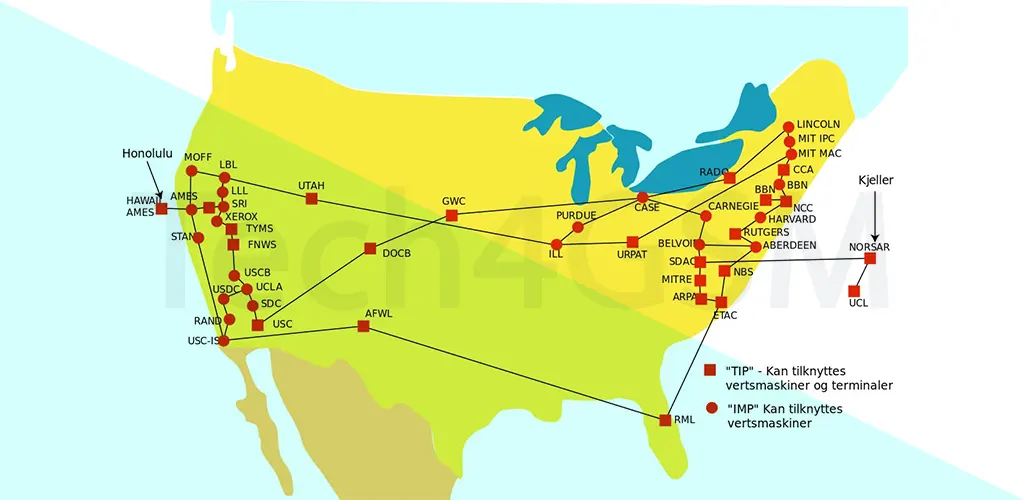
In 1969, the U.S. Department of Defense’s Advanced Research Projects Agency (ARPA) launched ARPANET. The goal? Connect computers across universities and research labs to share information faster. The first message was sent between UCLA and Stanford—though it crashed after just two letters (“LO”)!
By the 1970s, ARPANET expanded, introducing email for collaboration. But its biggest leap came in 1983 with the adoption of TCP/IP protocols, a universal “language” for data transfer. This turned scattered networks into a single, global system—the early internet. By 1980, ARPANET split into civilian and military branches, with the latter becoming the Defense Data Network.
Key Features of ARPANET
What made ARPANET special? Here’s a quick look:
- WAN (Wide Area Network): Connected computers over long distances.
- Packet-Switching: Broke data into small “packets” for efficient transfer.
- IMPs (Interface Message Processors): Early routers that directed traffic between devices.
- Split Software: Separated user-facing “hosts” from the backbone “subnet.”
Why ARPANET Was a Game-Changer
- Survived Disasters: Built to work even during a nuclear attack, thanks to its decentralized design.
- Email Revolution: Allowed researchers to collaborate via fast messaging, replacing slow mail.
- Military & Science Boost: Securely transferred critical defense data and academic research.
Limitations of ARPANET
Despite its genius, ARPANET faced challenges:
- LAN Overload: As local networks (LANs) multiplied, managing connections became messy.
- Tech Evolution: It struggled to keep up with rapid advancements, leading to its retirement in 1990.
ARPANET’s Legacy in 2025
While ARPANET is gone, its DNA lives on. Modern internet—from social media to cloud computing—owes everything to its pioneering framework.
So next time you send an email or stream a video, remember: it all started with a few smart computers talking to each other in 1969. ARPANET didn’t just build the internet—it built the future.