Introduction
In today’s data-driven world, securing sensitive information is non-negotiable. DCL (Data Control Language) plays a pivotal role in safeguarding databases by controlling who accesses what. Whether you’re a developer, admin, or tech enthusiast, understanding DCL is essential for mastering SQL. Let’s dive into this critical topic, breaking down its commands, benefits, and real-world applications—all in simple language!
What is DCL? Full Form and Purpose
DCL stands for Data Control Language, a subset of SQL (Structured Query Language). Its primary purpose is to manage permissions and access rights within a database. Think of it as a digital security guard—it decides who can view, edit, or delete data, ensuring only authorized users interact with sensitive information.
Why Do We Need DCL Commands?
- Prevent Unauthorized Access: Stop hackers or accidental data leaks.
- Granular Control: Admins can assign specific permissions (e.g., “View only” or “Edit access”).
- Compliance: Meet legal requirements like GDPR or HIPAA by restricting data exposure.
- Efficiency: Reduce risks of data corruption by limiting unnecessary user actions.
Without DCL, your database could become a free-for-all, risking breaches and chaos.
Two Types of Privileges in Databases
DCL manages two privilege categories:
1. System Privilege
- Grants high-level access to perform administrative tasks.
- Examples: Creating databases, altering server settings, or managing user accounts.
- Typically reserved for database admins or senior roles.
2. Object Privilege
- Controls access to specific database objects like tables, views, or stored procedures.
- Examples: Allowing a user to SELECT data from a “Customers” table but not DELETE it.
DCL Commands: GRANT and REVOKE
DCL revolves around two core commands:
1. GRANT Command
This gives users permission to perform actions on database objects.
Syntax:
GRANT privilege_list ON object_name TO user_name;
Example:
GRANT SELECT, UPDATE ON Employees TO JohnDoe;
Here, JohnDoe can view and update the “Employees” table but can’t delete it.
Common Privileges:
- SELECT: Read data.
- INSERT: Add new data.
- UPDATE: Modify existing data.
- DELETE: Remove data.
- EXECUTE: Run stored procedures.
- ALL: Full access (use cautiously!).
2. REVOKE Command
This removes previously granted permissions.
Syntax:
REVOKE privilege_list ON object_name FROM user_name;
Example:
REVOKE DELETE ON Customers FROM JaneSmith;
JaneSmith loses the ability to delete records from the “Customers” table.
Advantages of DCL Commands
- Enhanced Security: Protect sensitive data from unauthorized users.
- Flexibility: Assign roles like “Read-Only User” or “Editor” effortlessly.
- Audit-Friendly: Track who did what, simplifying compliance audits.
- Minimized Human Error: Restrict risky actions like accidental deletions.
Disadvantages of DCL
- Complex Permissions: Managing roles in large databases can get messy.
- No Data Manipulation: DCL can’t insert, update, or delete data (that’s DML’s job).
- Security Risks: Incorrect GRANT/REVOKE use might expose data.
- Dependency: Requires existing DDL/DML structures to work.
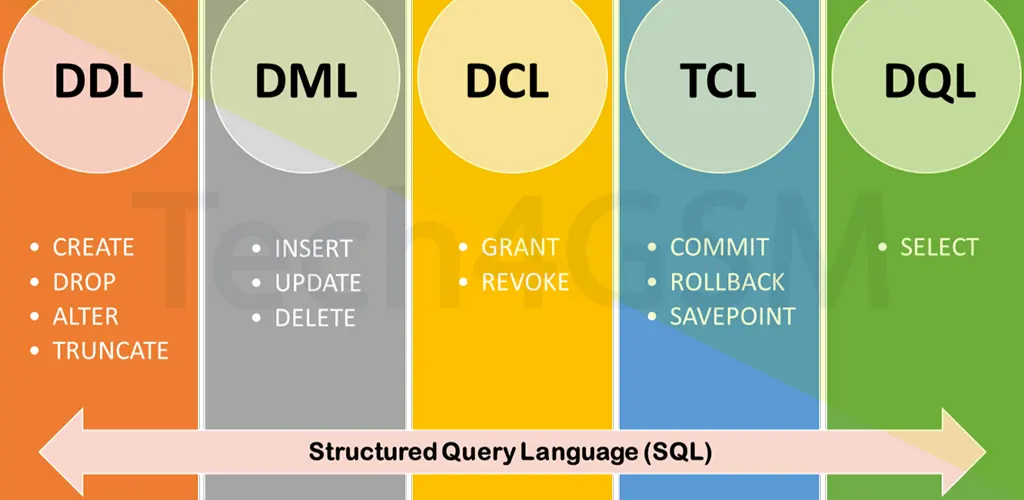
DCL vs. DML vs. DDL: What’s the Difference?
- DCL (Data Control Language): Manages access (e.g., GRANT, REVOKE).
- DML (Data Manipulation Language): Handles data changes (e.g., INSERT, UPDATE).
- DDL (Data Definition Language): Creates/modifies structures (e.g., CREATE TABLE).
DCL Best Practices for 2025
- Least Privilege Principle: Grant only necessary permissions.
- Regular Audits: Review user roles periodically.
- Use Roles: Group privileges into roles (e.g., “Analyst” or “Admin”) for easier management.
- Backup Permissions: Document GRANT/REVOKE scripts for recovery.
FAQ Section
Q1: What does DCL stand for?
A: DCL stands for Data Control Language, used to manage database access via GRANT and REVOKE.
Q2: Can DCL commands be rolled back?
A: Yes, in some databases, DCL operations can be rolled back within transactions.
Q3: Who manages DCL in organizations?
A: Typically database administrators (DBAs) or security teams.
Q4: Is DCL enough for full database security?
A: No, combine DCL with encryption, firewalls, and monitoring for robust security.
Q5: How do I practice DCL commands?
A: Use platforms like MySQL or PostgreSQL.
Conclusion
DCL is the backbone of database security in 2025, balancing accessibility with protection. By mastering GRANT and REVOKE, you’ll ensure data remains in the right hands while staying compliant with evolving regulations.