Introduction
In the digital world, Transmission Control Protocol (TCP) is like a trusted postal service that ensures your data packages (messages) reach their destination safely and in order. Let’s break down how TCP works, why it’s essential, and what makes it unique—all in simple terms!
What is TCP?
TCP is a connection-oriented protocol that guarantees error-free, ordered data delivery between devices (like your phone and a website’s server). It’s part of the TCP/IP suite and operates at the transport layer (Layer 4) of the OSI model. Think of TCP as a reliable middleman between apps (e.g., your browser) and the internet.
- Works with IP: TCP teams up with Internet Protocol (IP), which routes data packets using unique IP addresses.
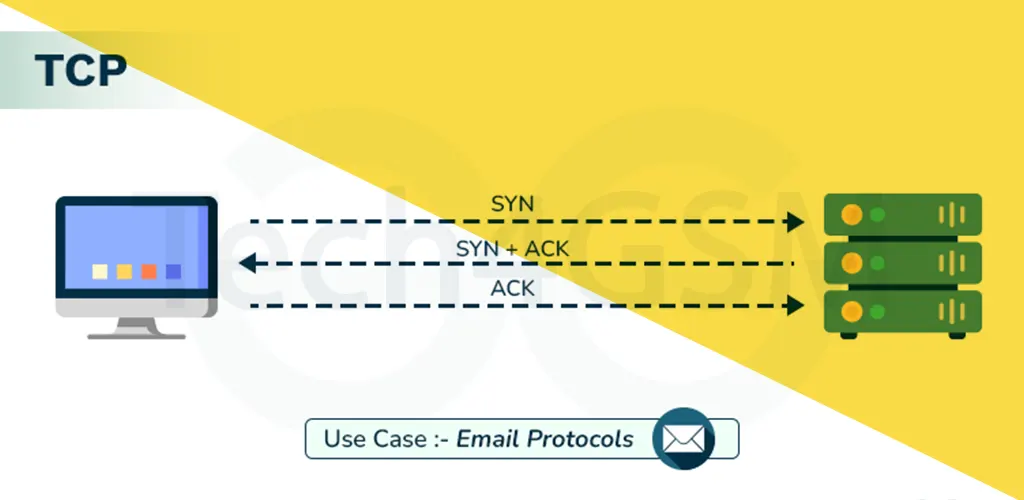
- Three-Way Handshake: Establishes connections using SYN, SYN-ACK, ACK signals.
- Four-Step Goodbye: Closes connections gracefully with FIN, ACK, FIN, ACK.
How Does TCP Work?
Imagine sending a 100-page book through the mail. Instead of shipping it all at once, TCP splits the data into smaller packets, sends them via different routes (to avoid traffic jams), and reassembles them perfectly at the destination.
Example:
- You request a video on tech4gsm.com.
- The server uses HTTP to ask TCP to send the video.
- TCP splits the video into packets and forwards them to IP.
- IP routes these packets through the fastest paths.
- Your device’s TCP layer waits for acknowledgments (ACKs) and reassembles the packets.
Key Features of TCP
- Segment Numbering: Each packet gets a unique number to track order.
- Error Control: Uses checksums to detect and retransmit corrupted data.
- Flow Control: Adjusts data speed to match the receiver’s capacity (like a smart faucet).
- Congestion Control: Algorithms like Slow Start and Fast Retransmit prevent network overload.
- Full Duplex: Data flows both ways simultaneously (like a phone call).
Pros and Cons of TCP
Advantages:
- ✔️ Reliable: No lost or jumbled data.
- ✔️ Error Recovery: Fixes issues automatically.
- ✔️ Widely Used: Supported globally (thank IETF standards!).
Disadvantages:
- ❌ Slow for Small Networks: Overkill for simple setups.
- ❌ Complex Layers: Can slow down speed.
- ❌ Not Universal: Doesn’t work with Bluetooth or other stacks.
TCP vs. IP: What’s the Difference?
- TCP ensures data arrives correctly.
- IP focuses on routing packets to the right address.
Together, they’re the backbone of the internet!
FAQs About TCP
1. What is a Three-Way Handshake?
It’s TCP’s way to start a connection:
- Device A sends SYN (“Hello?”).
- Device B replies SYN-ACK (“Hello back!”).
- Device A sends ACK (“Got it!”).
2. Why is the TCP Header Important?
It holds critical info like port numbers and flags to manage data delivery.
3. Can TCP Handle Unreliable Transfers?
No! Use UDP (User Datagram Protocol) for quick, non-critical data (like live streams).
4. Is TCP Still Relevant in 2025?
Absolutely! It remains vital for web browsing, emails, and secure transfers.
Final Thoughts
TCP is the unsung hero of the internet, ensuring your cat videos load smoothly and emails arrive intact. While newer tech evolves, TCP’s reliability keeps it irreplaceable.
Stay connected, stay informed—TCP makes it possible!