Introduction
Imagine a world without laptops, smartphones, or even calculators. This was reality until the mid-20th century when pioneers built the first electronic computers. Among these groundbreaking machines were ENIAC, EDVAC, and EDSAC—three giants that laid the foundation for modern computing. In this article, we’ll explore their history, how they worked, and why they matter even in 2025. Let’s dive in!
What Was ENIAC? The First General-Purpose Computer
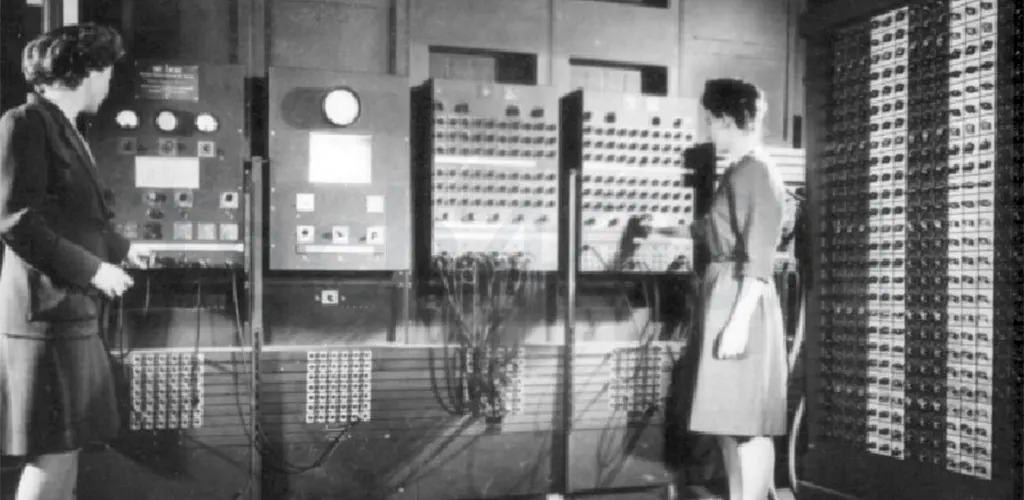
ENIAC (Electronic Numerical Integrator And Computer) was a revolutionary machine developed during World War II. Here’s what made it special:
- First Turing-Complete Digital Computer: ENIAC could solve any computable problem, making it a trailblazer in flexibility.
- Built for the U.S. Army: Its primary task was calculating artillery firing tables to improve military accuracy.
- Massive and Power-Hungry: Weighing 30 tons and using 18,000 vacuum tubes, ENIAC consumed as much power as 1,500 modern heaters!
- Reprogrammable, But Not Easily: Unlike today’s computers, reprogramming ENIAC required manually rewiring circuits—a process taking days.
Why ENIAC Matters:
ENIAC proved electronic computers could outperform humans in complex calculations. However, its lack of stored programs limited efficiency. (Learn about vacuum tubes at tech4gsm.com)
EDVAC: The Birth of the Stored-Program Concept
EDVAC (Electronic Discrete Variable Automatic Computer) was ENIAC’s smarter successor. Designed by John von Neumann, EDVAC introduced ideas still used in 2025:
- Binary System: EDVAC processed data in binary (0s and 1s), making it faster and simpler than ENIAC’s decimal system.
- Stored-Program Architecture: Programs were stored in memory alongside data, eliminating manual rewiring. This “von Neumann architecture” is the backbone of modern computers.
- Faster and More Reliable: EDVAC’s design reduced errors and sped up processing, setting new standards.
EDVAC’s Legacy:
Though completed in 1949, EDVAC’s principles revolutionized software development. Its influence is evident in every device from smartphones to supercomputers.
EDSAC: The First Practical Stored-Program Computer
While EDVAC was still theoretical, EDSAC (Electronic Delay Storage Automatic Calculator) brought ideas to life. Built in the UK by Maurice Wilkes in 1949, EDSAC marked a milestone:
- First Operational Stored-Program Computer: EDSAC ran its first program in 1949, calculating square numbers.
- Inspired by Von Neumann: Wilkes used the EDVAC report to create a practical machine, proving stored-program concepts worked.
- User-Friendly for Its Time: Scientists used EDSAC for real-world tasks like biology and economics research.
Why EDSAC Stands Out:
EDSAC’s success encouraged universities and businesses to adopt computers, sparking the digital age. (Discover early computing milestones at tech4gsm.com)
ENIAC vs EDVAC vs EDSAC: Key Differences
- Programming:
- ENIAC: Manual rewiring.
- EDVAC/EDSAC: Stored programs in memory.
- Number System:
- ENIAC: Decimal.
- EDVAC/EDSAC: Binary.
- Impact:
- ENIAC proved electronic computing was possible.
- EDVAC introduced critical theories.
- EDSAC turned theory into reality.
Legacy in 2025: How These Machines Shape Modern Tech
Even in 2025, the DNA of ENIAC, EDVAC, and EDSAC lives on:
- Von Neumann Architecture: Still used in 99% of computers.
- Binary Computing: The basis of all digital systems.
- Software Development: Stored programs enabled apps, AI, and cloud computing.
FAQs
Q1: Which was the first computer, ENIAC or EDSAC?
ENIAC (1945) came first, but EDSAC (1949) was the first practical stored-program computer.
Q2: Why is EDVAC less famous than ENIAC?
ENIAC’s wartime role gave it more publicity, but EDVAC’s design was more influential long-term.
Q3: Are these early computers still in use?
No, but replicas exist in museums. Their ideas, however, are everywhere in 2025.
Q4: How did EDSAC improve on EDVAC’s design?
EDSAC simplified EDVAC’s plans, making stored-program computing functional sooner.
Conclusion
ENIAC, EDVAC, and EDSAC were more than just machines—they were visions of the future. Their stories remind us that today’s tech marvels, from smartphones to AI, owe their existence to these pioneers. As we advance into 2025 and beyond, understanding our digital roots helps us innovate smarter.