Introduction
In today’s tech-driven world, Digital to Analog Converters (DACs) play a silent yet critical role in transforming digital data into the analog signals we interact with daily. From streaming music to watching 4K videos, DACs ensure seamless conversion, making them indispensable in modern electronics. Let’s break down what DACs are, how they work, and why they matter in 2025.
What is a DAC?
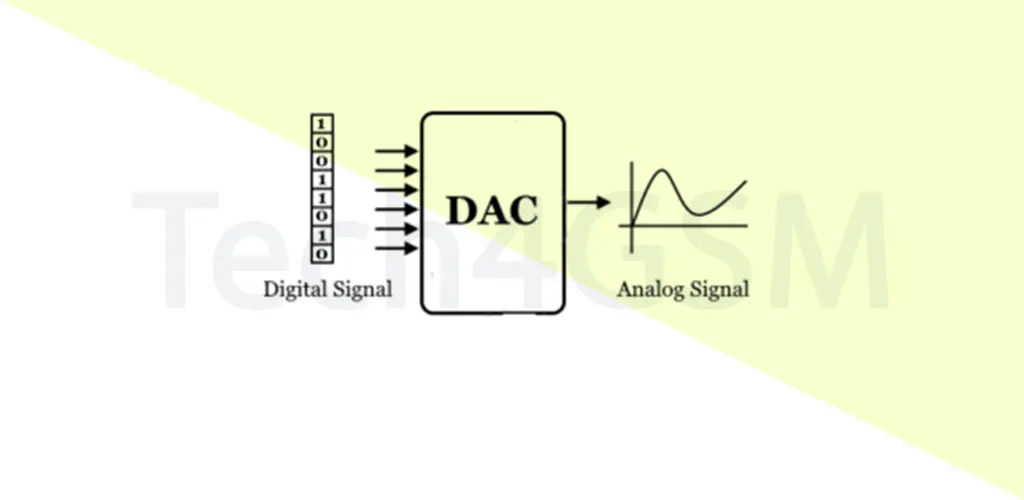
A Digital to analog Converter (DAC) is a device that converts binary code (0s and 1s) into analog signals like sound, light, or voltage. Think of it as a translator: your smartphone stores music digitally, but your headphones need analog waves to produce sound. The DAC bridges this gap.
Key Takeaway: Without DACs, your digital devices couldn’t interact with the analog world!
How Does a DAC Work?
Imagine a DAC as a team of tiny switches (bits) working together. Each switch represents a binary value (0 = off, 1 = on). The more switches (bits) a DAC has, the finer the details it can reproduce.

Block Diagram of a DAC
- Digital Input: Receives binary code (e.g., 1010).
- Conversion Circuit: Uses resistors or networks to process the input.
- Analog Output: Produces a continuous voltage or current.
For example, a 3-bit DAC can create 8 (2³) different output levels. Higher bit counts (like 16-bit or 24-bit) offer smoother, more accurate signals—crucial for high-fidelity audio.
Types of DACs
DACs come in two primary designs, each with pros and cons:
1. Weighted Resistor DAC
This type uses a network of binary-weighted resistors (e.g., 1KΩ, 2KΩ, 4KΩ) to convert digital inputs.
How It Works:
- Each resistor corresponds to a bit (LSB to MSB).
- When a bit is 1, the switch connects to a reference voltage (-Vᵣ).
- The op-amp sums these voltages to create the analog output.
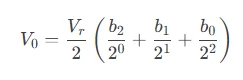
Output Voltage Formula:
Drawbacks:
- Resistor Precision: Requires highly accurate resistors, which get harder to source as bit count increases.
- Complexity: Impractical for high-resolution applications (e.g., 16-bit audio).
Best For: Low-cost, low-bit applications like simple sensors.
2. R-2R Ladder DAC
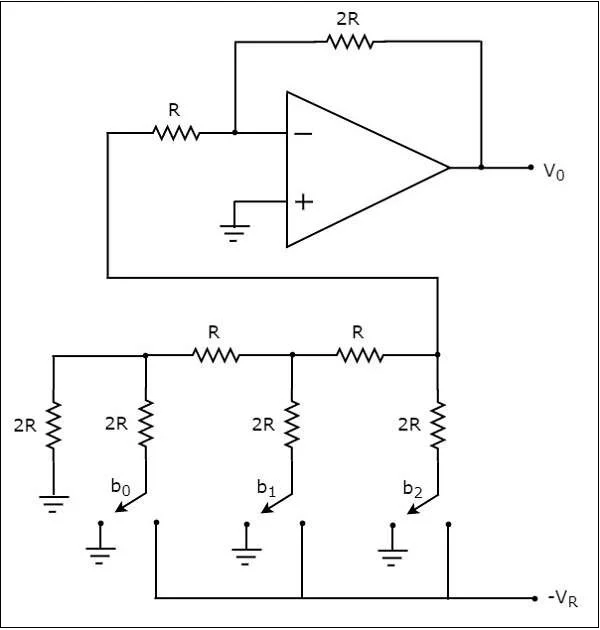
This design uses only two resistor values (R and 2R) arranged in a ladder-like pattern, solving the weighted resistor’s limitations.
How It Works:
- Each “rung” of the ladder handles a bit.
- The network splits voltage evenly, ensuring consistent impedance.
Advantages:
- Simpler Resistors: Easy to mass-produce accurate R and 2R resistors.
- Scalability: Add more R-2R sections for higher bit counts without complexity.
Best For: High-resolution needs like audio interfaces, medical devices, and 2025’s 8K video systems.
Pro Tip: Most modern DACs (like those in your Bluetooth headphones) use R-2R designs for reliability.
Let’s break down how a 3-bit binary weighted resistor DAC converts digital inputs to analog outputs, step by step.
Step 1: The Circuit Basics
- Inputs: 3 digital bits (b₂, b₁, b₀), where b₂ = MSB (Most Significant Bit) and b₀ = LSB (Least Significant Bit).
- Resistors: Binary-weighted values (R, 2R, 4R for b₀, b₁, b₂, respectively).
- Op-Amp: Acts as a summing amplifier, converting current to voltage.
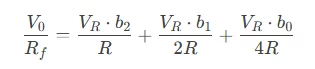
Step 2: The Nodal Equation
At the inverting terminal of the op-amp (virtual ground = 0V), the total current from all bits equals the feedback current:

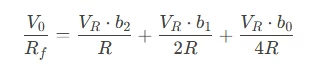
Simplifying (since bits are either 0 or 1):
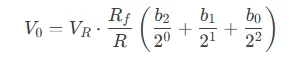
Step 3: Solving for Output Voltage (V₀)
Factor out VR/R:
Substitute R=2Rf (common design choice to simplify):
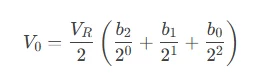
Example Output for 3-Bit DAC
If the input is b₂b₁b₀ = 101 (binary for 5):

Total Possible Outputs:
With 3 bits, you get 23=8 values (from 000 to 111), e.g., 0V, 0.125VR, 0.25VR, …, 0.875VR.
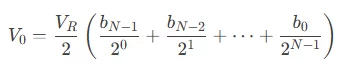
Generalized Formula for N-Bit DAC
For an N-bit DAC, the output voltage becomes:
Why This Design Fails for High-Bit Systems
- Resistor Imbalance:
- For an 8-bit DAC, resistors range from R (MSB) to 128R (LSB).
- Example: A 1% tolerance resistor for the LSB (128R) could have an error of ±1.28R, causing significant inaccuracies.
- Manufacturing Challenges:
- Producing precise high-value resistors (e.g., 10-bit DAC needs 512R) is costly and error-prone.
Practical Takeaway
- Weighted resistor DACs work for low-bit systems (e.g., 3-4 bits) but struggle with high resolution.
- Solution: Modern systems use R-2R Ladder DACs (uses only two resistor values: R and 2R), eliminating scalability issues.
Why DACs Matter in 2025
As technology advances, the demand for precision grows:
- Gaming: Immersive 3D audio requires 24-bit DACs.
- Healthcare: Medical imaging relies on ultra-accurate analog signals.
- Smart Homes: DACs enable voice assistants to decode commands clearly.
FAQ Section
Q1: Can a DAC improve my phone’s sound quality?
Yes! External DACs bypass low-quality built-in converters, offering richer audio.
Q2: Are all DACs the same?
No—differences in bit depth (e.g., 16-bit vs. 24-bit) and design (R-2R vs. weighted) affect performance.
Q3: Do I need a DAC for my TV?
If you’re using analog speakers or headphones, your TV’s built-in DAC is sufficient. For home theaters, consider an upgrade.
Q4: How do I choose a DAC?
Match it to your needs:
- Music Production: 24-bit R-2R DACs.
- Casual Use: Affordable USB-C DACs.
Q5: What’s next for DAC technology in 2025?
Expect AI-integrated DACs that auto-optimize signals for your environment, as seen in tech4gsm.com’s latest audio gear reviews.
Final Thoughts
Whether you’re a tech enthusiast or a casual user, understanding DACs helps you make informed choices. From the resistor-heavy designs of the past to the sleek R-2R systems of 2025, DACs continue to evolve—pushing the boundaries of clarity and precision.