Introduction
In today’s fast-paced digital world, staying connected is vital. But how do entire cities manage seamless communication? Enter the Metropolitan Area Network (MAN)—a powerful network bridging local systems across urban landscapes. Let’s explore what makes MANs essential, their evolution, and their role in modern connectivity.
What is a Metropolitan Area Network (MAN)?
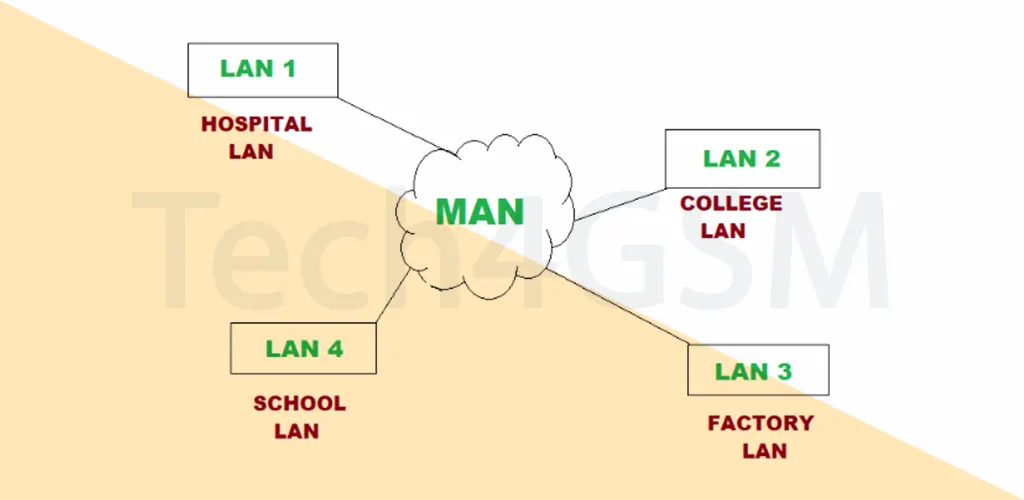
A Metropolitan Area Network (MAN) is a high-speed network connecting multiple Local Area Networks (LANs) across a city or metropolitan region. Imagine linking offices, campuses, or hospitals within a city to share data, resources, and internet access efficiently. MANs fill the gap between smaller LANs (like your home Wi-Fi) and vast Wide Area Networks (WANs) that span countries.
- Coverage: Ranges from 5 km to 50 km—ideal for cities.
- Speed: Delivers 10-100 Mbps using fiber optics, wireless, or copper cables.
- Purpose: Enables resource sharing (printers, servers), video conferencing, and centralized data management.
The Evolution of MAN
Back in 1994, businesses relied on telephone networks to connect LANs, but these couldn’t handle heavy data traffic. The solution? Fiber-optic cables. By linking LANs via fiber optics, MANs emerged, offering faster, reliable connectivity. Today, MANs blend private and public networks, supporting everything from streaming services to disaster recovery systems.
Key Features of MAN
- High-Speed Connectivity: Fiber optics ensure lightning-fast data transfer.
- Dual Bus Architecture: Supports two-way data flow for efficient communication.
- Hybrid Topology: Combines ring, bus, and star layouts for flexibility.
- Centralized Control: Simplifies network management and security.
- Scalability: Easily expands as urban needs grow.
Pros and Cons of MAN
Advantages:
✅ Faster than WANs, with fewer delays.
✅ Enhanced security protocols.
✅ Serves thousands of users simultaneously.
✅ Ideal for real-time applications like video streaming.
Challenges:
❌ Expensive setup (fiber optics aren’t cheap!).
❌ Complex design and maintenance.
❌ Limited fault tolerance compared to LANs.
Where is MAN Used?
- Cable TV Networks: Streaming HD content citywide.
- Government & Hospitals: Sharing data across departments.
- Universities: Connecting libraries, labs, and dorms.
- Disaster Recovery: Ensuring backup communication during emergencies.
Building a MAN: Step-by-Step
- Core Infrastructure: Fiber-optic cables form the backbone, linked by high-capacity routers.
- Distribution Layer: Manages data flow between core and access layers.
- Access Layer: Connects end-users via switches and routers.
- Security & Management: Firewalls, VPNs, and monitoring tools safeguard data.
- Redundancy: Backup systems prevent downtime during failures.
MAN vs. CAN: What’s the Difference?
| Aspect | MAN | CAN (Campus Area Network) |
|---|---|---|
| Scope | Covers entire cities | Limited to campuses or facilities |
| Users | Thousands across a city | Hundreds within a campus |
| Technology | Fiber optics, wireless | Wired connections (Ethernet) |
| Purpose | Link LANs for urban connectivity | Connect buildings in a single site |
FAQs: Quick Answers
Q: How is MAN different from LAN and WAN?
A: MAN covers a city, LAN a small area (like an office), and WAN spans countries.
Q: Why choose MAN over LAN?
A: MAN offers higher speeds over longer distances, perfect for citywide connectivity.
Q: Are MANs expensive?
A: Initial setup costs are high due to fiber optics, but long-term benefits outweigh costs.
The Future of MAN
By 2025, MANs will play a bigger role in smart cities, supporting IoT devices, 5G networks, and real-time data analytics. With advancements in wireless tech (like Wi-Fi 6), MANs will become more affordable and adaptable.
Final Thoughts
A Metropolitan Area Network is the unsung hero behind a city’s digital heartbeat. By interconnecting LANs with fiber optics and smart design, MANs keep businesses, hospitals, and governments running smoothly. Whether it’s streaming a movie or saving lives through shared medical data, MANs make it possible—proving that in connectivity, size truly matters!