Introduction
Imagine a world where making a phone call, sending a fax, and browsing the internet required separate lines. Before the Integrated Services Digital Network (ISDN), this was the reality! ISDN revolutionized telecommunications by enabling simultaneous digital transmission of voice, video, and data over traditional phone lines. Although newer technologies have since emerged, ISDN laid the groundwork for modern digital communication. In this guide, we’ll explore everything about ISDN—its history, types, services, and why it’s still relevant to understand in 2025.
What is ISDN?
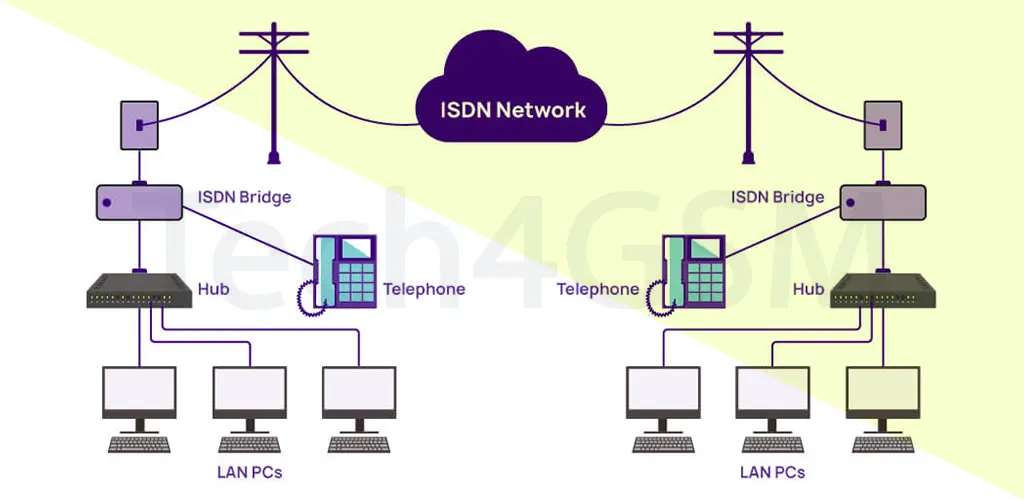
ISDN (Integrated Services Digital Network) is a set of communication protocols that transformed analog phone lines into digital powerhouses. Unlike old systems, ISDN allowed users to send voice, video, and data at the same time over a single line. Here’s why it stood out:
- Digital Over Analog: ISDN replaced crackling analog signals with crisp digital transmissions.
- Speed: Offered up to 128 kbps by bonding two 64 kbps channels (BRI) or higher speeds with PRI.
- Versatility: Supported video conferencing, online gaming, and fast file transfers in the pre-broadband era.
History of ISDN
From Analog to Digital Revolution
Before ISDN, phone lines were voice-only, with data transmission as an afterthought. ISDN emerged in the 1980s as a game-changer:
- 1986: ITU-T standardized ISDN protocols (Q.931), enabling end-to-end digital calls.
- Key Milestone: Allowed integrated services (e.g., video calls) on one line.
- B-ISDN: Later evolved to use fiber optics for faster speeds, though overshadowed by DSL and fiber broadband.
Types of ISDN Interfaces
ISDN came in three flavors, each catering to different needs:
1. Basic Rate Interface (BRI)
- Channels: 2 B-channels (64 kbps each) + 1 D-channel (16 kbps for signaling).
- Total Speed: 144 kbps (192 kbps with overhead).
- Use Case: Perfect for homes and small businesses. Need to fax while browsing? BRI made it possible!
2. Primary Rate Interface (PRI)
- Channels: 23 B-channels + 1 D-channel (64 kbps each) in the U.S./Japan; 30 B-channels in Europe.
- Total Speed: 1.544 Mbps (T1) or 2.048 Mbps (E1).
- Use Case: Ideal for large companies requiring multiple simultaneous calls.
3. Broadband ISDN (B-ISDN)
- Tech: Leveraged fiber optics for speeds beyond PRI (up to hundreds of Mbps).
- Legacy: Paved the way for today’s fiber broadband but was phased out due to high costs.
ISDN Services
ISDN offered three categories of services:
1. Bearer Services
- Function: Raw data transfer (no content manipulation).
- Example: Sending a file while on a call.
- OSI Layers: Operated at Layers 1-3 (Physical, Data Link, Network).
2. Teleservices
- Function: Advanced processing like video calls or fax.
- Example: Teleconferencing with screen sharing.
- OSI Layers: Layers 4-7 (Transport to Application).
3. Supplementary Services
- Function: Added perks like call waiting, caller ID, and reverse charging.
- Example: Putting a call on hold to answer another.
How Does ISDN Work?
ISDN’s magic lies in its digital channels and standardized protocols:
- D-Channel Signaling: The D-channel sets up calls (e.g., dialing a number) before handing off to B-channels.
- B-Channel Data Transfer: Each B-channel handles voice, video, or data at 64 kbps.
- Channel Bonding: Combine B-channels for higher speeds (e.g., 128 kbps with BRI).
Advantages of ISDN
- Speed: Blazing-fast 128 kbps in the 90s!
- Reliability: Crystal-clear calls with minimal noise.
- Multitasking: Surf the web while on a call.
- Global Standards: Uniform protocols enabled cross-country compatibility.
Disadvantages of ISDN
- Cost: Expensive installation and monthly fees.
- Complex Setup: Required specialized modems and routers.
- Speed Limits: Outpaced by DSL and fiber optics by the 2000s.
- Limited Coverage: Rural areas often lacked ISDN infrastructure.
ISDN in 2025: Is It Still Relevant?
While ISDN is largely phased out in 2025, its legacy lives on:
- VoIP Precursor: Techniques like channel bonding inspired modern VoIP.
- Niche Uses: Some legacy systems in healthcare or aviation still rely on ISDN.
- Historical Significance: Taught in networking courses for its foundational role.
Conclusion
ISDN was the bridge between analog phones and today’s digital world. Though replaced by faster, cheaper technologies, it remains a milestone in telecom history. Understanding ISDN helps appreciate how far we’ve come—and where we’re headed next!
FAQ
Q1. What are B and D channels in ISDN?
- B (Bearer): Carries voice/data (64 kbps each).
- D (Data): Manages signaling (16/64 kbps).
Q2. What’s ISDN’s maximum speed?
- 128 kbps (BRI) or 1.544 Mbps (PRI).
Q3. Is ISDN full-duplex?
- Yes! It allows simultaneous two-way communication.
Q4. Which OSI layers does ISDN use?
- Primarily Data Link (Layer 2) and Network (Layer 3).
Q5. Is ISDN still used in 2025?
Rarely, except in specific legacy systems.