Introduction
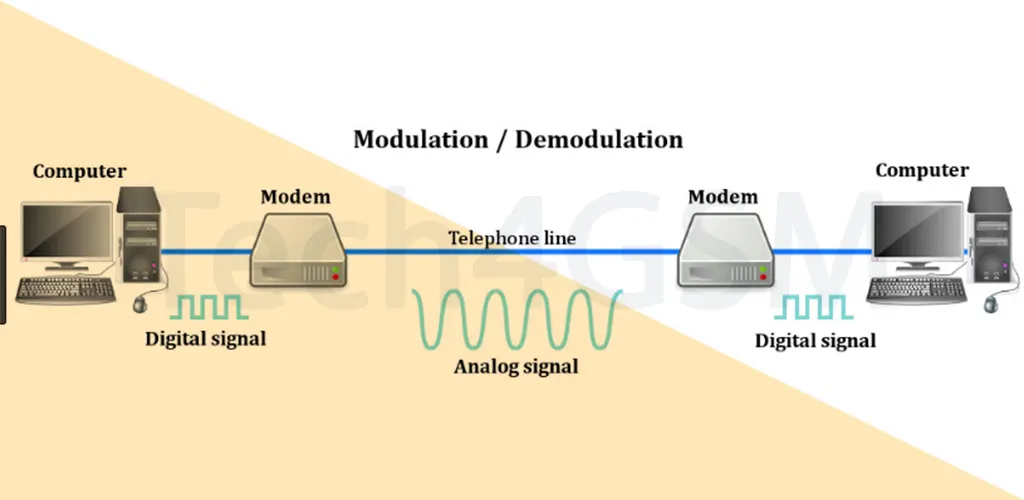
Have you ever wondered how your computer sends emails or streams videos over the internet? The magic lies in a device called a MODEM (Modulator and Demodulator). It acts as a bridge, converting signals between your digital devices and the analog world of cables or phone lines. Let’s break down how modulation and demodulation work, their differences, and why they matter in 2025!
What is Modulation?
Modulation is the process of converting digital signals (like data from your laptop) into analog signals (like radio waves). Imagine you’re talking into a microphone: your voice is an analog signal (continuous waves), but computers understand only digital signals (discrete 0s and 1s). Modulation transforms these digital signals into analog form for transmission.
Example:
- A TV without a set-top box receives analog signals from a cable operator.
- When you record your voice on a computer, the microphone converts your analog voice into digital data.
In simple terms, modulation superimposes high-frequency waves onto low-frequency data, making it travel farther without wires.
How Does Modulation Work?
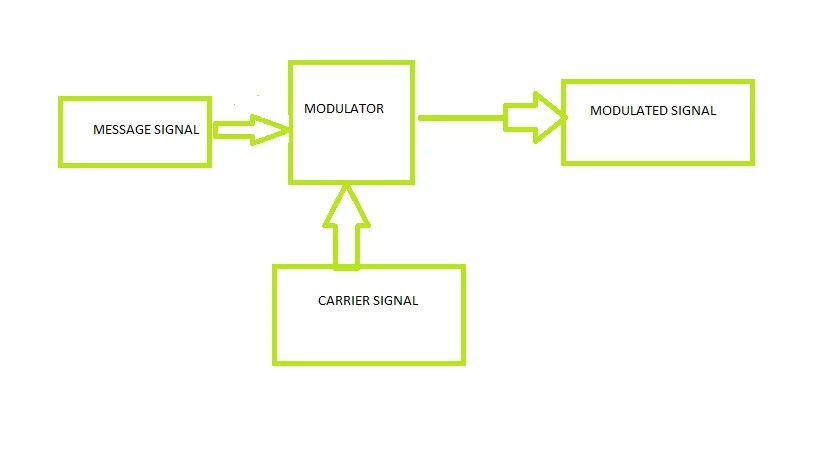
Modulation uses a carrier signal (a steady wave with fixed amplitude, frequency, or phase) and combines it with your data. The result is a modulated signal ready for transmission.
Types of Modulation
- Amplitude Modulation (AM): Changes the carrier wave’s height (amplitude) to encode data. Used in radio broadcasting.
- Frequency Modulation (FM): Alters the wave’s frequency (how often it repeats). Common in FM radio and walkie-talkies.
- Phase Modulation (PM): Shifts the wave’s starting point (phase). Used in Wi-Fi and satellite communication.
Pros of Modulation:
- Reduces antenna size.
- Minimizes signal interference.
- Extends communication range.
Cons of Modulation:
- Requires costly equipment.
- Complex to implement.
What is Demodulation?
Demodulation is the reverse process—converting analog signals back into digital data. Think of it as translating a secret code back into readable text.
Example:
- A set-top box demodulates analog signals from a cable into digital formats for your TV.
How Does Demodulation Work?
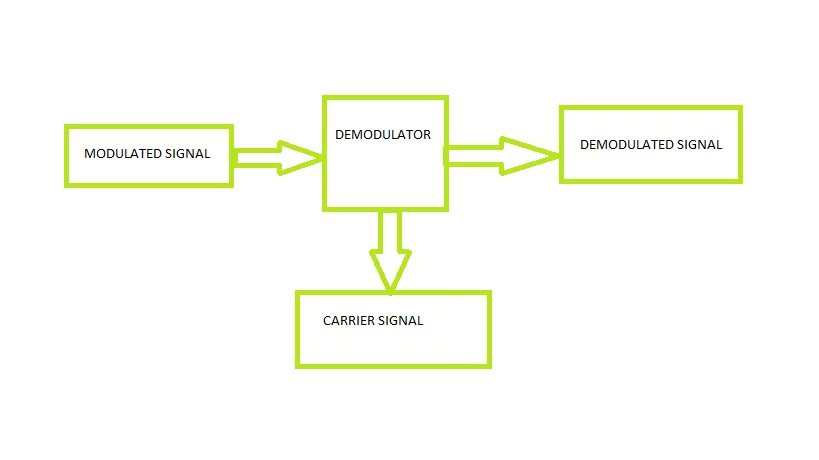
A demodulator circuit extracts the original data from the modulated signal. For instance, your modem receives analog signals through an antenna, demodulates them, and delivers digital output (like a video or webpage).
Types of Demodulation
- AM Demodulation: Uses a rectifier to decode amplitude changes.
- FM Demodulation: Employs phase-locked loops to detect frequency shifts.
- PM Demodulation: Relies on phase detectors to track phase variations.
Pros of Demodulation:
- Enhances signal clarity.
- Boosts reliability.
Cons of Demodulation:
- High power consumption.
- Expensive hardware.
Modulation vs. Demodulation: Key Differences
| Feature | Modulation | Demodulation |
|---|---|---|
| Definition | Converts digital data into analog signals for transmission. | Extracts original digital data from received analog signals. |
| Device Connection | Applied at the sender’s side (transmitter). | Applied at the receiver’s side. |
| Signal Conversion | Encodes digital information into carrier waves. | Decodes carrier waves back to usable digital data. |
| Frequency Shift | Boosts frequency for long-distance transmission. | Reverts frequency to its original usable level. |
| Complexity Level | Less technically demanding. | More intricate due to signal extraction challenges. |
| Signal Direction | Prepares signals for wireless/analog transfer. | Restores signals for digital device use. |
| Key Component | Uses a modulator circuit. | Uses a demodulator circuit. |
Key Takeaways:
- Purpose: Modulation prepares data for travel (like packaging a parcel), while demodulation unpacks it at the destination.
- Frequency: Modulation “lifts” signals to higher frequencies; demodulation “brings them back down.”
- Role in Communication: Both processes are essential for wireless tech, internet, and broadcasting systems.
FAQs About MODEMs
1. Why do we need modulation and demodulation?
Modulation allows data to travel wirelessly over long distances, while demodulation decodes it for your devices. Together, they power internet, TV, and mobile networks.
2. What device performs both processes?
A modem (Modulator + Demodulator).
3. What’s the main benefit of modulation?
It reduces antenna size and eliminates wiring—key for wireless tech in 2025!
4. Is demodulation power-hungry?
Yes, due to complex signal extraction processes.
Final Thoughts
As we step into 2025, modems continue to evolve, enabling faster internet and smarter devices. Understanding modulation and demodulation helps you appreciate the invisible tech that keeps us connected!