Introduction
PDU stands for Protocol Data Unit. Think of it as a “data package” that travels across a network. Just like a courier parcel has a sender’s address, receiver’s address, and the actual item inside, a PDU contains headers (control information) and a payload (the real data). Whether you’re browsing a website or sending an email, PDUs work behind the scenes to ensure your data reaches its destination.
In this guide, we’ll break down PDUs in simple terms, explore their role in networking, and answer all your questions. Let’s dive in!
How is a PDU Structured?
A PDU’s structure depends on the protocol being used, but it generally has two parts:
- Header: Contains control details like source/destination addresses, error-checking codes, and sequencing info.
- Payload: The actual data being transmitted (e.g., text, images, or video).
For example, in an IP packet (a type of PDU), the header includes the sender’s IP, the receiver’s IP, and the packet’s lifespan (TTL). The payload could be part of a video stream or webpage.
PDUs in the OSI Model: The Layered Approach
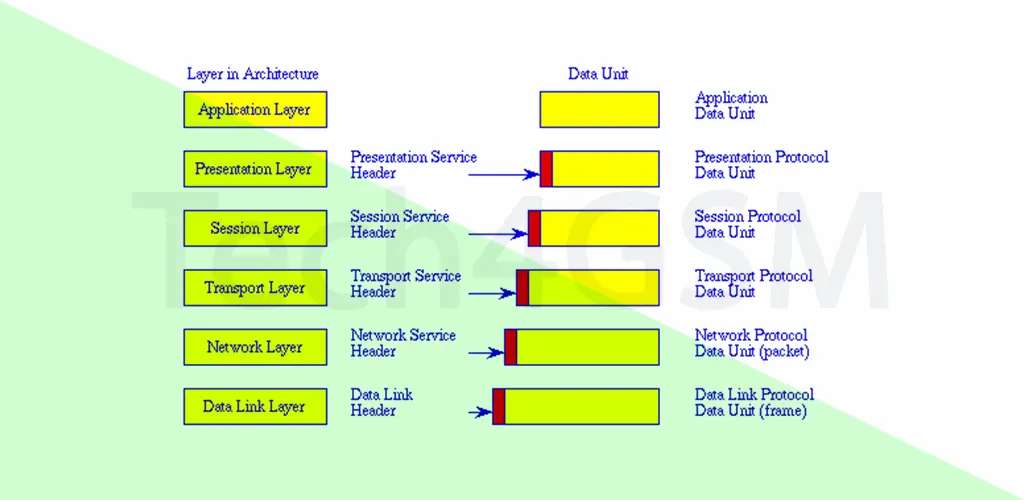
The OSI model has 7 layers, and each layer adds its own header to the PDU. Here’s how it works:
- Application Layer: Your data (like an email) starts here.
- Transport Layer: Adds a header with port numbers (e.g., TCP/UDP). Now it’s called a segment.
- Network Layer: Adds IP addresses. Now it’s a packet.
- Data Link Layer: Adds MAC addresses. Now it’s a frame.
- Physical Layer: Converts frames into bits for transmission.
This encapsulation ensures each layer handles specific tasks. For instance, routers work with packets (Network Layer), while switches handle frames (Data Link Layer).
PDU vs. Frame vs. Packet: What’s the Difference?
- PDU: A generic term for data units at any layer (e.g., segment, packet, frame).
- Frame: A PDU at the Data Link Layer (Layer 2). Contains MAC addresses.
- Packet: A PDU at the Network Layer (Layer 3). Contains IP addresses.
Imagine mailing a book:
- The packet is the entire book with a shipping label (IP addresses).
- The frame is each individual page with a sticky note (MAC addresses) for the postman.
Why Are PDUs Important in Networking?
- Troubleshooting: Network admins analyze PDUs to find issues like corrupted headers or routing errors.
- Efficiency: Properly structured PDUs reduce data overhead.
- Compatibility: Standardized PDUs let devices from different brands communicate (e.g., Cisco routers with Huawei switches).
For example, if your video call is lagging, checking the PDUs might reveal packet loss at the Network Layer.
Can PDUs Be Modified During Transmission?
Yes, but only the headers! The payload (your data) stays intact. Routers often change headers to update TTL values or reroute traffic. Firewalls might block PDUs with suspicious headers.
PDU Structure Across Protocols
Different protocols use unique PDU formats:
- TCP: Headers include sequence numbers (to reorder data) and ACK flags (to confirm delivery).
- HTTP/3: Uses QUIC protocol PDUs for faster streaming.
Common Types of PDUs
- Ethernet Frames (Data Link Layer): Used in LANs.
- IP Packets (Network Layer): For internet communication.
- TCP Segments (Transport Layer): Ensures reliable delivery.
Standardized PDUs: Why Do They Matter?
Imagine if every country had its own traffic rules—chaos, right? Standardized PDUs (e.g., IEEE 802.3 for Ethernet) ensure global interoperability. Devices follow the same rules, so your iPhone can talk to a Samsung server.
PDU Size and Network Performance
- Larger PDUs: Reduce overhead but risk fragmentation.
- Smaller PDUs: Increase overhead but are easier to transmit.
For example, jumbo frames (9000+ bytes) improve LAN efficiency but aren’t supported everywhere.
Fragmentation: Breaking Down PDUs
If a PDU exceeds the network’s MTU (Maximum Transmission Unit), it’s split into smaller fragments. Think of moving a large sofa through a narrow door—you disassemble it first!
PDUs and Network Congestion
Too many small PDUs flood the network (like spam emails), causing congestion. Larger PDUs reduce traffic but take longer to resend if lost. Balance is key!
PDUs and Security
PDUs can include:
- Encryption: Scrambling payloads (e.g., HTTPS).
- Authentication: Verifying sender identity (e.g., digital signatures).
FAQs About PDUs
- Q: Is a PDU the same as an SDU?
A: No! A Service Data Unit (SDU) is the data passed between layers, while a PDU includes headers. - Q: How do PDUs affect internet speed?
A: Smaller PDUs mean more overhead, slowing speed. Larger PDUs optimize bandwidth but require stable connections. - Q: Can PDUs work in 5G networks?
A: Yes! PDUs adapt to protocols like 5G-NR for ultra-low latency. - Q: What’s the future of PDUs in 2025?
A: Expect AI-driven PDUs with dynamic header optimization for smarter networks.
Conclusion
PDUs are the unsung heroes of networking. From structuring data to ensuring secure delivery, they keep our digital world connected. By 2025, advancements in AI and 5G will make PDUs even more efficient. Whether you’re a student or a network engineer, understanding PDUs is your gateway to mastering modern tech.