Introduction
Ever wondered how your browser finds websites? The secret lies in URLs! Let’s explore what URLs are, how they work, and why they matter in 2025.
What Is a URL? Full Form & Basics
URL stands for Uniform Resource Locator – the “address” of any webpage, image, or file online. Created by Tim Berners-Lee (the father of the web) and the Internet Engineering Task Force in 1994, URLs act like GPS coordinates for the internet.
Example:
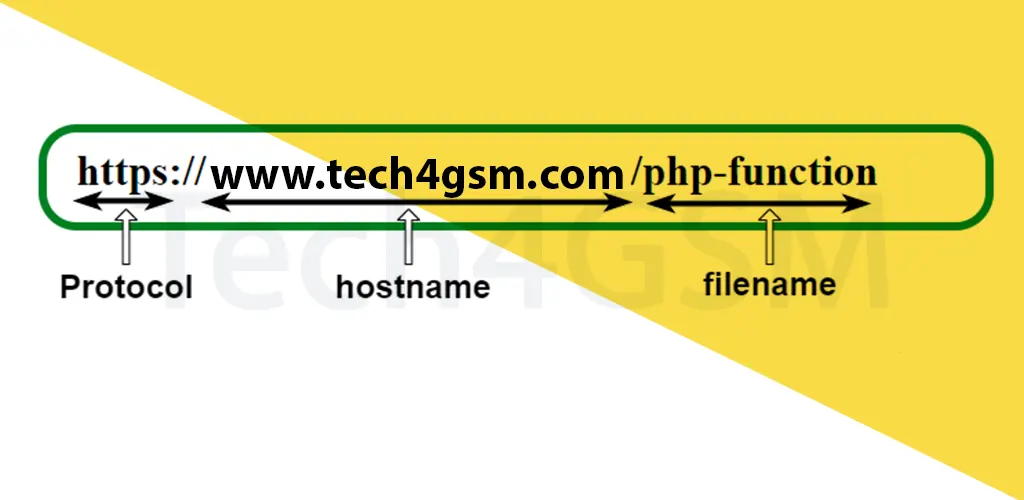
https://tech4gsm.com/php-function
- Protocol:
https - Hostname:
tech4gsm.com - Filename:
/php-function
Parts of a URL: Breaking It Down
A URL is like a digital street address with specific components:
- Protocol:
- The “language” your browser uses to communicate (e.g.,
http://,https://,ftp://). - HTTPS (with a padlock 🔒) is the secure default in 2025, encrypting data for safety.
- The “language” your browser uses to communicate (e.g.,
- Hostname (Domain):
- The website’s name (e.g.,
tech4gsm.com). - Think of it as the neighborhood where the resource “lives.”
- The website’s name (e.g.,
- Port:
- Hidden by default (e.g.,
:443for HTTPS). - Only visible if manually added, like
tech4gsm.com:8080.
- Hidden by default (e.g.,
- Path:
- The exact “house” on the street (e.g.,
/php-functionguides you to a specific page).
- The exact “house” on the street (e.g.,
URL Syntax Made Simple
All URLs follow this structure:
protocol://hostname/path
- Real-World Analogy:
- Protocol = Transportation method (car, bike).
- Hostname = Street name (e.g., “Tech4GSM Street”).
- Path = House number (e.g., “PHP Function Villa”).
Why Do URLs Matter in 2025?
- Navigation: URLs let you jump to any online resource instantly.
- SEO: Clean URLs (like
tech4gsm.com/useful-links/) rank higher on Google. - Security: HTTPS ensures data privacy, crucial for e-commerce and logins.
- Sharing: Memorable URLs make content easy to share (e.g.,
tech4gsm.com/contact-us/).
URL vs. URI: What’s the Difference?
- URL: A specific address (e.g.,
https://tech4gsm.com). - URI (Uniform Resource Identifier): A broader term that includes URLs and names (URNs).
Fun Fact
The first URL ever created was http://info.cern.ch in 1991. Today, over 2 billion websites use URLs!
FAQ: Quick Answers About URLs
1. What does “URL” stand for?
- Uniform Resource Locator – the official term for a web address.
2. Who invented URLs?
- Tim Berners-Lee and his team in 1994.
3. Are URLs case-sensitive?
- Yes!
Tech4GSM.comandtech4gsm.commight lead to different pages.
4. Why use HTTPS in URLs?
- Security: Encrypts data to protect passwords and payments.
5. Can I change a URL?
- Yes, but use 301 redirects to avoid breaking links.
Conclusion
URLs are the unsung heroes of the internet, guiding billions daily to their online destinations. In 2025, understanding how they work helps you browse smarter, optimize websites, and stay secure.