Introduction
In the digital world, computers and devices store data as numbers. For humans to understand this data, it must be converted into text or symbols—this is where encoding schemes come into play. These schemes are the backbone of computing, allowing us to process, store, and transmit information efficiently. Among these, EBCDIC stands out as a unique system still vital to industries worldwide. Let’s explore its history, workings, and why it remains relevant in 2025.
What is EBCDIC?
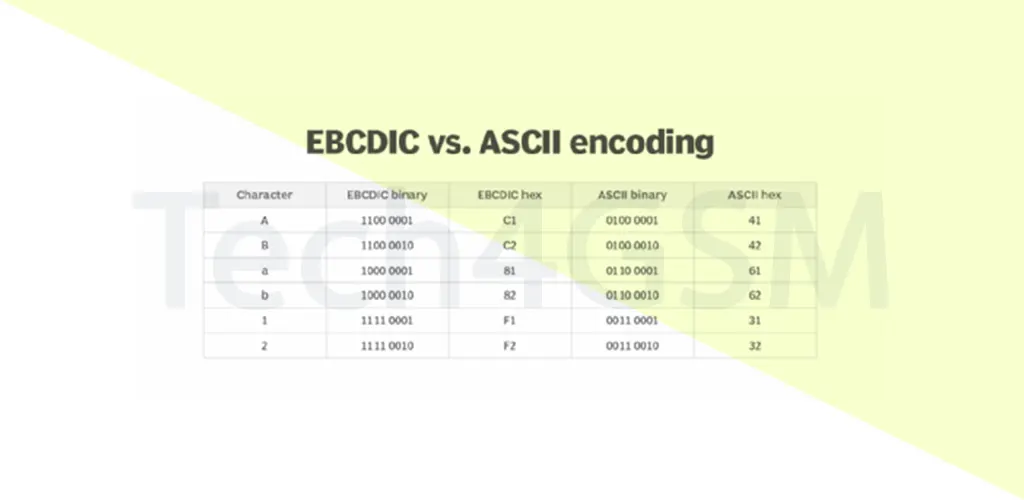
EBCDIC (Extended Binary Coded Decimal Interchange Code) is an 8-bit character encoding system developed by IBM in 1964. Unlike modern standards like ASCII, EBCDIC was designed for early IBM mainframes, enabling them to represent letters, numbers, punctuation, and control characters using 8-bit binary numbers (0-255). This was a significant upgrade from older 6-bit systems, offering more flexibility for business computing.
While ASCII dominates today’s personal computers, EBCDIC persists in legacy systems, particularly in sectors like banking, insurance, and logistics. For instance, many global banks still rely on IBM mainframes running EBCDIC to process millions of transactions daily.
How Does EBCDIC Work?
EBCDIC translates text into binary through a predefined mapping table. Here’s a simplified breakdown:
- Mapping Table Referenced
Every character (e.g., ‘A’, ‘5’, ‘%’) has a unique 8-bit code stored in a table. For example, the letter ‘W’ corresponds to 11100110 in binary (E6 in hexadecimal). - Text Character Selected
The system picks the first character from the input. Let’s take “Hello” starting with ‘H’. - Binary Value Lookup
The table is checked for ‘H’, which maps to 11001000 (C8 in hex). - Binary Value Stored
This binary code is saved for processing or transmission. - Process Repeated
The system moves to the next character (‘e’ = 10010101) until the entire text is encoded. - Decoding for Output
To display data, the binary is converted back using the same table.
This method ensured compatibility with early IBM hardware, maximizing storage efficiency on tapes and punch cards.
Applications of EBCDIC in 2025
Despite its age, EBCDIC is far from obsolete. Here’s where it’s still used:
- Legacy System Support: Critical applications in banking and government built decades ago still run on EBCDIC. Transitioning them risks system failures.
- IBM Mainframes: IBM’s Z-series servers, used by 92% of top global banks, rely on EBCDIC for core operations.
- Multilingual Support: Later EBCDIC versions added accents, Cyrillic, and Asian scripts, aiding global businesses.
- Industry Data Standards: Automotive and manufacturing sectors use EBCDIC for compatibility with old inventory systems.
For example, airlines use EBCDIC-based mainframes to manage reservations—a system too costly and complex to replace.
Advantages of EBCDIC
- Legacy System Lifeline: Powers irreplaceable systems in finance and logistics.
- Reliability: Ensures 24/7 uptime for IBM mainframes, crucial for stock exchanges.
- Storage Efficiency: Compact encoding suited for vintage storage media.
- Global Adaptability: Supports diverse languages, unlike early ASCII.
Disadvantages of EBCDIC
- Modern Incompatibility: New devices lack native EBCDIC support, requiring costly middleware.
- Translation Errors: Converting EBCDIC to ASCII can corrupt data.
- Skill Shortage: Fewer experts understand EBCDIC as retirees exit the workforce.
- Security Risks: Outdated systems are vulnerable to cyberattacks.
The Future of EBCDIC
While migration to Unicode or ASCII grows, EBCDIC’s deep roots in industries mean it won’t vanish soon. Experts predict its decline post-2030 as cloud computing matures. However, for now, it remains the unsung hero of backend infrastructure.
FAQ
1. Why does EBCDIC use 8-bit encoding?
IBM designed it for 8-bit byte efficiency, accommodating business symbols and multilingual text beyond ASCII’s 7-bit limit.
2. Can EBCDIC files work on modern systems?
Not directly—they require translation tools like IBM’s DataGate or custom middleware.
3. Does EBCDIC support emojis or new symbols?
No. It’s limited to legacy business and language characters, lacking modern symbols.
4. Is EBCDIC secure?
Its age poses risks, but mainframes often use additional security layers to mitigate threats.
5. Will EBCDIC disappear?
Not soon. Critical systems still depend on it, and migration could take decades.