Introduction
Imagine taking hundreds of photos, downloading apps, or storing your favorite playlist without worrying about losing data when your phone dies. That’s the magic of NAND memory—a silent superstar in your gadgets. Let’s dive into what makes it so special and why it’s everywhere, from smartphones to USB drives!
1. What Is NAND Memory?
NAND memory is a popular type of flash memory—the same tech that lets your devices store data even when turned off. Think of it like a digital notebook that never loses its notes, even if you close the book. Unlike your computer’s RAM (which forgets everything when powered down), NAND is non-volatile, meaning it holds onto data without needing electricity.
2. Flash Memory 101: The Backbone of Modern Storage
Flash memory (including NAND) is a rewritable, durable, and portable storage solution. It’s why your USB drive survives being tossed in a bag or why your phone remembers your apps after a reboot. Key features:
- Affordable: Cheap to produce, making gadgets cheaper for you.
- Compact: Fits into tiny devices like smartwatches or earbuds.
- Tough: Resists shocks, heat, and daily wear better than hard drives.
- Energy-efficient: Sips battery power, perfect for portable devices.
3. NAND vs. NOR Flash: What’s the Difference?
While both are flash memory types, NAND and NOR serve different purposes:
- NAND: Built for high-capacity storage (like your phone’s 128GB memory). It’s cheaper, faster for writing/erasing data, and ideal for apps, photos, and videos.
- NOR: Designed for speedier read operations, often used to store critical code (e.g., a device’s firmware). However, it’s pricier and stores less data.
Simple analogy: NAND is like a spacious warehouse for bulk storage, while NOR is a quick-access toolbox for essential tools.
4. Why NAND Dominates Your Gadgets
From your SD card to your laptop’s SSD, NAND memory is everywhere because:
- Holds Tons of Data: A fingernail-sized chip can store terabytes.
- Speeds Up Devices: SSDs with NAND boot up computers in seconds.
- Makes Tech Affordable: Lower production costs mean cheaper phones, tablets, and storage devices.
- Lasts Longer: With no moving parts, NAND chips outlive traditional hard drives.
5. How NAND Memory Works (In Plain English!)
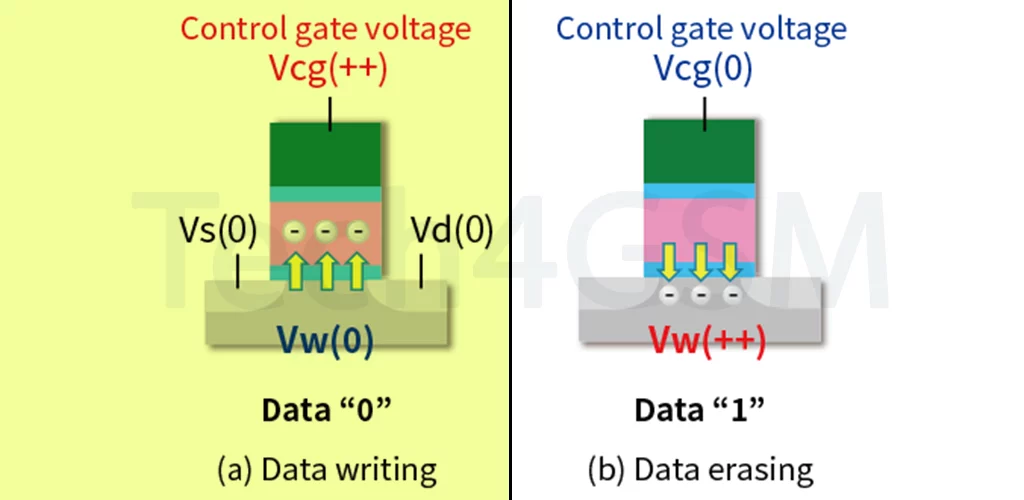
Picture a grid of tiny “cells” that trap electrons to represent 0s and 1s (binary data). Here’s the breakdown:
- Writing Data: Electric charges “fill” cells to store bits.
- Erasing Data: A voltage reset clears the cells for new data.
- Reading Data: The chip checks which cells are charged to retrieve your files.
Fun Fact: NAND gets its name from the “NOT AND” logic gate used in its design!
6. Where You’ll Find NAND Memory
- Smartphones/Tablets: Stores apps, photos, and OS.
- USB Drives: Portable file transfers.
- SSDs: Replaces slow hard drives in laptops.
- Memory Cards: Expands camera or drone storage.
- Smart Devices: Powers storage in wearables, IoT gadgets, and gaming consoles.
The Future of NAND: Smaller, Faster, Smarter
Tech giants are racing to develop 3D NAND, stacking memory cells vertically (like a skyscraper) to boost storage without increasing chip size. This means even tinier devices with massive storage—imagine a phone with 1TB space!
Final Thoughts: Why NAND Memory Matters to You
Next time you snap a photo or download a movie, thank NAND memory for keeping your data safe, accessible, and portable.
Pro Tip: Avoid filling NAND storage (like SSDs) to 100%—it slows them down! Keep at least 10-20% free for optimal performance. 🚀